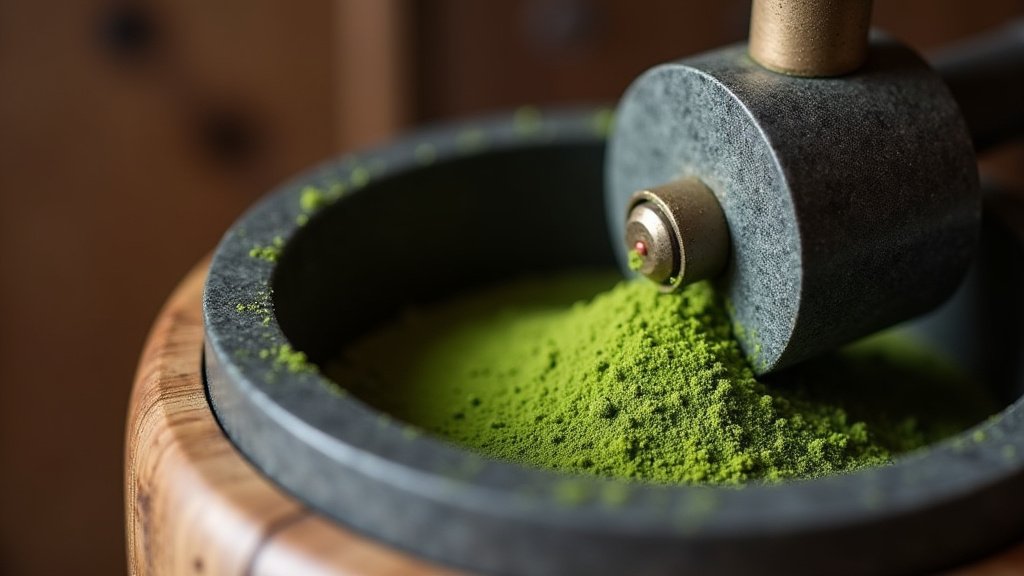
San Francisco’s Richmond district has become home to a singular culinary innovation: Constance Tea & Matcha, the first and only establishment on the West Coast to integrate traditional Japanese Ishi Usu stone mills for on-site production. By committing to the arduous process of stone-grinding tencha leaves in-house, the shop creates a level of freshness and textural complexity that has largely vanished from the commercial tea market, prioritizing the integrity of the leaf over industrial speed.
Key Highlights
- Traditional Milling: The shop utilizes authentic Ishi Usu granite stone mills, a centuries-old technology designed to grind tea leaves without generating the heat that degrades delicate flavor profiles.
- Production Efficiency: To protect the leaves from thermal damage, the shop limits production to just 30 grams per hour—a slow, deliberate process that ensures peak quality.
- Regional First: Constance Tea & Matcha currently stands as the only cafe on the entire West Coast to employ this traditional method on-site.
- Freshness Focused: By grinding on-site, the establishment minimizes the time between oxidation and consumption, preserving the vibrant green chlorophyll and antioxidant properties of the tencha.
The Art and Thermodynamics of the Ishi Usu Grind
In an era dominated by high-speed ball mills and industrial blenders, the decision by Constance Tea & Matcha to adopt the Ishi Usu—the traditional stone mill used for centuries in Japanese tea ceremonies—is a bold statement in favor of slow craft. For the uninitiated, the matcha production process begins long before the powder hits the whisk. It starts with tencha, a specific shade-grown green tea leaf that is deveined and destemmed before the grinding phase. In most commercial operations, high-speed grinding is utilized to meet demand. However, this process creates friction and heat, which accelerates oxidation and essentially ‘cooks’ the delicate tea leaves during the milling phase, robbing the matcha of its bright color and complex, grassy aromatics.
Protecting the Integrity of the Leaf
The Ishi Usu mill functions on a principle of low-friction, gravity-fed pulverization. The granite stones, carved with specific grooves, are designed to shear the leaf into microscopic particles without generating significant thermal energy. This is precisely why Constance Tea & Matcha imposes a strict output limit of 30 grams per hour. By strictly controlling the speed and the thermal environment, the shop ensures the leaves remain cool throughout the transition from leaf to powder. This temperature control is the difference between a dull, bitter cup of tea and the vibrant, umami-rich experience associated with high-grade ceremonial matcha. The result is a fine, velvety powder that retains the full spectrum of the leaf’s chemical components, including high levels of L-theanine and antioxidants.
The Richmond’s Artisanal Shift: A New Era for Tea
Beyond the technical merits of the stone mill, Constance Tea & Matcha represents a broader shift in the Richmond neighborhood’s culinary landscape. As San Francisco continues to grapple with the tension between convenience-driven dining and the resurgence of hyper-artisanal experiences, this shop provides a tangible example of the latter.
The Cultural Preservation of the Craft
The introduction of Ishi Usu mills is not merely a marketing gimmick; it is a form of cultural stewardship. The Japanese tea ceremony (chanoyu) places immense value on the process of preparation. By inviting customers into a space where the milling process is observable, the shop creates an educational loop, bridging the gap between the producer and the consumer. Customers are no longer just buying a drink; they are witnessing the final stage of a botanical transformation that requires patience, skill, and a deep respect for the ingredient.
The Economics of Niche Tea Consumption
Economically, the model at Constance Tea & Matcha is fascinating. In an industry where labor costs are high and floor space is expensive, dedicating energy to a 30-gram-per-hour output capacity might seem counterintuitive. Yet, this scarcity model positions the business in the premium tier. It caters to a growing demographic of consumers who prioritize ‘slow-food’ credentials and are willing to pay a premium for a product that is demonstrably superior to shelf-stable, mass-produced matcha. It suggests that even in a fast-paced urban environment, there is a viable, sustainable market for businesses that refuse to sacrifice quality for scale.
Sensory Impact and Quality Control
The sensory experience of stone-ground matcha is distinct. The particles produced by granite mills tend to be more uniform and finer than those produced by metal blade grinders, which leads to a more consistent suspension in water. When whisked, this matcha produces a richer, more persistent foam. The absence of heat-induced oxidation ensures that the ‘nori-like’ or oceanic sweetness remains intact, providing an umami depth that is the hallmark of premium grade matcha. This is the sensory benchmark that Constance is establishing in the San Francisco tea scene.
A Future for Traditional Methods in Modern Urbanism
Can this model scale? Perhaps not in the traditional sense, but that is the point. The success of Constance Tea & Matcha indicates that there is a hunger for ‘process-forward’ food and beverage ventures. As urban dwellers become more disconnected from the sources of their food, the transparency offered by on-site production—seeing the stone, the leaves, and the powder—creates a level of trust that branding alone cannot achieve. Looking ahead, we may see more artisanal shops adopting these traditional methods not just for tea, but for various agricultural commodities, emphasizing that the ‘future’ of food may very well lie in the ‘past’ of manufacturing technology.
FAQ: People Also Ask
1. Why is the Ishi Usu stone mill better than a blender for matcha?
Conventional blenders or steel mills create friction-induced heat, which rapidly oxidizes tea leaves, degrading flavor and color. The Ishi Usu works at a low temperature, preserving the delicate aromatics and vibrant color of the tencha.
2. What is tencha?
Tencha is the base ingredient for matcha. It consists of shade-grown green tea leaves that have been deveined and destemmed. It is the raw material before it is ground into powder.
3. Is there a difference in taste with fresh-ground matcha?
Yes. Freshly ground matcha typically exhibits a stronger umami profile, a deeper, more vibrant green color, and a smoother mouthfeel compared to matcha that has been oxidized by shelf storage or thermal degradation during processing.
4. Why does the shop limit production to 30 grams per hour?
This limit is necessary to manage the temperature of the granite stones. If the mill runs too fast, the friction creates heat. By keeping the output low, the shop ensures the leaves remain cool and fresh during the entire milling process.