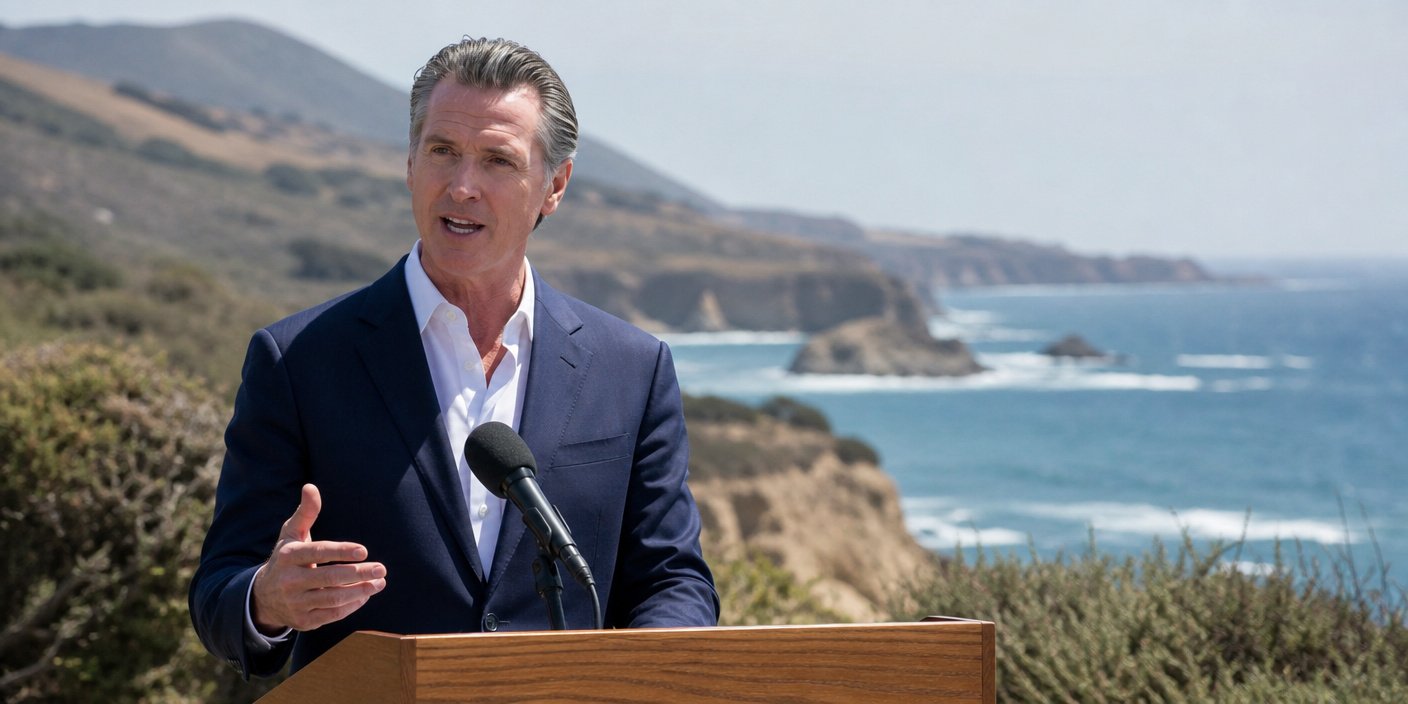
Governor Gavin Newsom is mobilizing California’s legal and administrative defenses against a recent move by the Trump administration to review the state’s federally approved Coastal Management Program. The administration, acting through federal agencies, has initiated a review process that Newsom and his legal team argue is a thinly veiled attempt to circumvent California’s long-standing authority to block offshore drilling and pipeline maintenance. This confrontation sets the stage for a high-stakes legal battle over the limits of federal versus state jurisdiction under the Coastal Zone Management Act (CZMA).
The Frontline of Federal Encroachment
The focal point of this developing crisis is the administration’s challenge to California’s Coastal Management Program. For decades, this federally recognized program has empowered the California Coastal Commission to act as a gatekeeper, reviewing and often rejecting federal projects that do not align with the state’s rigorous environmental and land-use standards. By targeting the program for review, the federal administration is attempting to weaken the Commission’s veto power, which has historically been the primary barrier preventing new offshore oil and gas extraction projects from commencing in state-managed waters.
Governor Newsom has characterized this administrative review not as a standard bureaucratic update, but as an aggressive encroachment on states’ rights. The argument from the Governor’s office is that the federal government is attempting to rewrite the rules of engagement mid-game, seeking to strip California of its ability to say “no” to oil infrastructure that could exacerbate climate change and threaten coastal ecosystems.
The Mechanical Reality of California’s Resistance
To understand the severity of this move, one must examine the role of the California Coastal Commission. The Commission is uniquely powerful because it operates with a dual mandate: environmental stewardship and public access. Unlike in many other states where federal jurisdiction effectively overrides local concerns, the California model relies on the “consistency” clause of the CZMA. This clause requires federal actions—including oil and gas lease sales or pipeline permits—to be consistent with the state’s coastal management policies.
When the federal government threatens this program, it is essentially trying to bypass the consistency clause. Without this mechanism, the state’s ability to enforce setbacks, restrict pipeline routes, or demand spill-containment technology would be severely diminished. The Trump administration’s strategy appears to be a multi-pronged effort to reclassify federal interests, potentially rendering the state’s environmental protections moot under the banner of “national energy security.”
Economic and Environmental Implications
Beyond the legal maneuvering, the potential impacts are tangible and severe. California’s coastline is the backbone of the state’s tourism and fishing industries, sectors that rely on pristine water quality and public accessibility. Environmental scientists point out that the infrastructure required for new offshore drilling—pipelines and platforms—poses a constant risk of oil spills, which can have catastrophic long-term effects on marine biodiversity, ranging from local kelp forests to regional whale migration paths.
Furthermore, the state economy, currently the largest in the U.S. with a GDP exceeding $3.8 trillion, is pivoting aggressively toward a green-energy future. Newsom’s administration argues that reviving offshore drilling is an “archaic and dangerous” backward step that contradicts the state’s climate goals. The administration contends that the costs associated with potential environmental cleanup and the disruption to the tourism economy far outweigh the marginal domestic energy gains from new drilling efforts.
The Path Ahead: Legal and Political Warfare
The administration’s review of California’s program is just the opening salvo in what is expected to be a protracted legal conflict. Legal experts anticipate that California will pursue litigation in federal court, arguing that the review process lacks statutory authority and violates the cooperative federalism principles embedded in the CZMA.
Governor Newsom has called on Californians to remain vigilant and engaged. This appeal is a strategic move to rally public sentiment, knowing that in the realm of environmental policy, popular opinion can influence administrative actions and pressure federal representatives. As the review process unfolds, the state is expected to leverage every available regulatory tool to ensure that federal mandates do not override the environmental standards Californians have voted for and upheld for decades. The battle is not just about oil; it is about who holds the pen when writing the regulations that govern the Pacific coast: the people of California or federal interests in Washington.