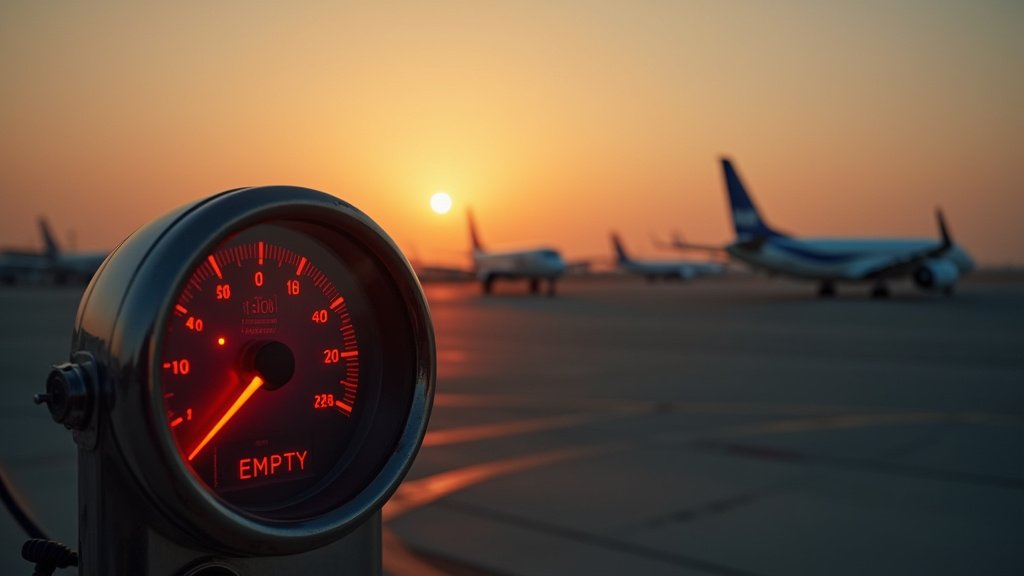
California’s aviation landscape is hovering on the brink of an unprecedented logistical crisis. Recent data indicates that jet fuel imports from Asia—a primary artery for the West Coast’s energy needs—have collapsed to their lowest levels in at least ten years. This decline, exacerbated by the permanent closure of two major regional refineries and the cascading effects of global maritime instability, has left the nation’s most populous state scrambling to secure sufficient fuel for its commercial and military aviation hubs. As of late April 2026, jet fuel stocks in the state have dipped to 2.6 million barrels, a sharp contraction that analysts warn could ground flights and spike airfares just as the peak summer travel season approaches.
Key Highlights
- Decade-Low Import Volumes: Jet fuel shipments from Asian refiners to California have cratered, with only one major cargo confirmation reported in the final weeks of April.
- Structural Refining Deficit: The state has effectively lost 20% of its refining capacity since late 2025 following the shuttering of the Phillips 66 Los Angeles refinery and the Valero Benicia facility.
- Geopolitical Pressure: Conflict in the Middle East has constricted traffic through the Strait of Hormuz, severing the crude oil pipelines that Asian refiners rely on to produce the jet fuel California desperately needs.
- Record-High Costs: Spot prices for jet fuel at major airports like LAX have surged, with some reports indicating costs reaching or exceeding $15 per gallon in localized supply-stressed scenarios, forcing airlines to consider drastic route adjustments.
The Perfect Storm: Unpacking California’s Energy Isolation
The current crisis is not a result of a singular failure, but rather a convergence of three distinct, yet deeply interconnected, supply-side shocks. To understand the severity of the situation, one must first recognize the unique energy architecture of California. Often described by economists as an “energy island,” the state is physically and structurally isolated from the dense network of interstate pipelines that keep the rest of the U.S. fueled. While the Gulf Coast and the Midwest enjoy fluid, multi-state connectivity, California relies heavily on a combination of in-state refining—which has been intentionally curtailed by regulatory shifts—and imported refined products.
The Refining Capacity Vacuum
For decades, California’s refining sector was the backbone of its economic stability. However, the operational landscape shifted dramatically in late 2025. The closure of the Phillips 66 refinery in Los Angeles and the Valero Energy facility in Benicia were not merely business decisions; they represented a massive, structural removal of manufacturing capacity. These two complexes combined for nearly 20% of the state’s total refining power. With this capacity offline, the burden of supply shifted almost entirely to foreign imports. When the local infrastructure failed to keep pace with demand, the state became hyper-dependent on the volatility of the global shipping market.
The Pacific Pipeline Disconnect
This reliance on imports from Asia was meant to be a reliable contingency. However, the global energy supply chain is not a static conveyor belt; it is a sensitive network of interdependencies. As tensions escalated in the Middle East, the Strait of Hormuz—the world’s most critical maritime chokepoint—became effectively impassable for many tankers. Asian refiners, who typically process Middle Eastern crude into jet fuel, found themselves starved of feedstock. Consequently, they had little surplus to export to the West Coast. The math became simple and brutal: no crude oil for Asia meant no jet fuel for California. The Jag Parth, a tanker carrying 210,000 barrels of jet fuel from South Korea, became a symbol of this scarcity—one of the few confirmed vessels on the water bound for California, highlighting the extreme thinness of the supply chain.
Cascading Economic Impacts on Aviation
The ripple effects of this fuel shortage are already being felt in the terminal. Airlines operate on thin margins, and fuel is typically the largest variable cost. When the price of Jet A-1 fuel spikes from historical averages to unprecedented highs, the impact is immediate and non-negotiable. For major carriers and budget airlines alike, the choice is binary: pass the cost on to the consumer via skyrocketing airfares or cancel routes that are no longer profitable.
Pricing Volatility at the Gate
Reports from major California airports, particularly Los Angeles International (LAX), indicate that spot prices have reached levels that would have been unimaginable just eighteen months ago. We are seeing numbers nearing $15 per gallon in specific supply-constrained instances. This level of volatility destroys the viability of shorter, regional flights. Airlines that operate these routes, already battling thin margins, cannot absorb such input costs. As a result, we are seeing a reduction in service to smaller regional hubs—like Burbank and Sacramento—which serves as a harbinger for broader service disruptions if inventories are not replenished quickly.
The Consumer and the World Stage
Travelers planning to enter the state for the upcoming 2026 World Cup and summer tourism are at the highest risk. Aviation experts warn that if the state cannot secure consistent tanker arrivals, the “black cloud” over aviation capacity could lead to mass cancellations. This is not just a commercial nuisance; it is an economic threat. Tourism in California is a massive industry, and a summer defined by grounded flights or prohibitive ticket prices could cost the state billions in lost revenue, further compounding the financial strain already felt by the hospitality and event sectors.
Strategy and Future Outlook: Is Recovery Possible?
The California Energy Commission (CEC) has maintained that they are closely monitoring the situation and coordinating with stakeholders to assess near-term risks. However, the reality of global logistics means that relief cannot be manufactured overnight. A tanker voyage from Asia across the Pacific takes weeks. Even if refiners were to ramp up production today, the physical logistics of getting that fuel into California’s storage tanks means the state will effectively be living off its reserves for the foreseeable future.
Regulatory Friction and Resilience
There is a growing debate regarding the state’s long-term energy policy. Critics argue that the regulatory environment—which has prioritized rapid transitions and stringent environmental standards—has left the state without the necessary buffer capacity to withstand global shocks. Proponents of these policies, however, argue that the focus on electrification and renewables is essential for long-term health, even if it causes short-term pain. Regardless of political alignment, the current crisis serves as a stark case study in the risks of transition: when you decouple from one energy source before the new infrastructure is mature, you leave yourself exposed to the raw volatility of the global market.
Strategic Reserves and The Long Game
In the coming months, the state may be forced to look into strategic fuel reserves or expedited infrastructure approvals to prevent a structural deficit from becoming a permanent fixture of California life. Whether these measures can be implemented fast enough to save the summer season remains the multi-billion dollar question. For now, the Pacific route is the only lifeline, and as the Jag Parth and other vessels slowly traverse the ocean, the aviation industry remains on high alert, watching every barrel of supply with intense focus.
FAQ: People Also Ask
1. Why is California more affected by this fuel shortage than the rest of the US?
California is geographically isolated from the major interstate oil pipeline networks that connect the rest of the country. While the Gulf Coast can easily shift supplies via rail or pipeline, California relies on local refineries and maritime imports. When local refineries close and global shipping routes are disrupted, the state has no secondary pipeline network to draw from, making it uniquely vulnerable.
2. Will this lead to flight cancellations for the general public?
It is possible. As fuel costs rise and supply tightens, airlines may choose to cancel less profitable routes or consolidate flights to conserve fuel. Travelers should monitor their flight status closely, particularly on regional routes where carriers have less margin to absorb fuel price spikes.
3. Is this a long-term problem or a short-term blip?
This is currently a structural issue. Because the state has lost 20% of its refining capacity permanently, it will be structurally dependent on imports for the long term. Unless new supply chains are solidified or internal capacity is somehow increased, the state will remain susceptible to global shipping volatility for the foreseeable future.
4. What is the role of the Strait of Hormuz in this issue?
Much of the world’s crude oil, which Asian refiners use to produce jet fuel, passes through the Strait of Hormuz. When this route is disrupted by conflict, Asian refiners struggle to get the crude oil they need to produce refined products like jet fuel, leading to a bottleneck that eventually reaches California’s ports.