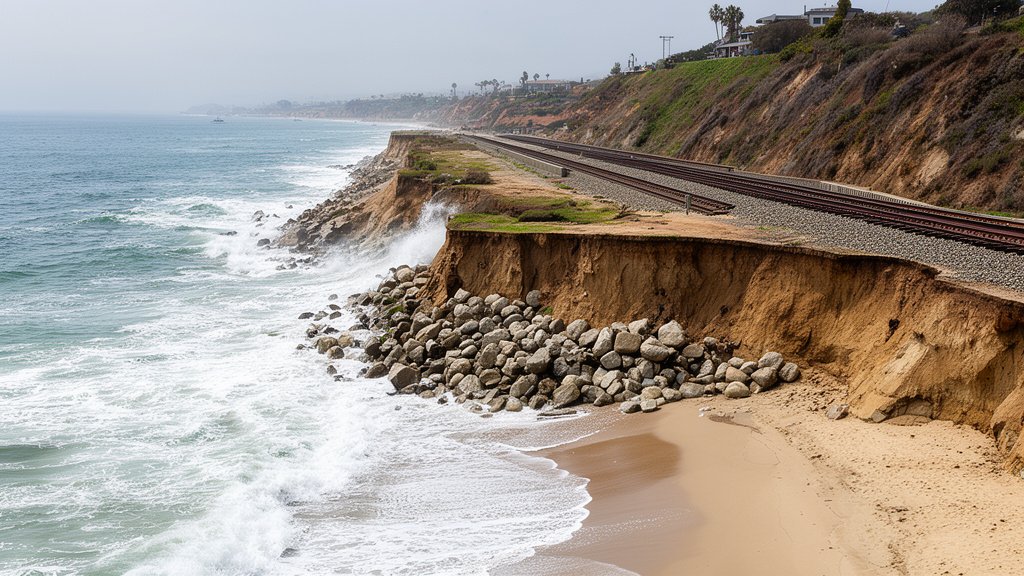
San Clemente is currently caught in a desperate race against time as relentless coastal erosion threatens to swallow both its iconic beaches and a critical artery of Southern California’s transportation network. The crisis centers on the LOSSAN rail corridor, a 351-mile lifeline that serves as the second-busiest passenger rail line in the United States, which has been subjected to repeated shutdowns due to shifting soil and crumbling cliffs. Driven by intensified wave action from the 2023-2024 Super El Niño weather pattern, the city is grappling with the catastrophic intersection of climate instability and aging infrastructure.
Key Highlights:
- The LOSSAN rail corridor, vital for commuters and Amtrak Pacific Surfliner services, has faced repeated, lengthy shutdowns due to landslides and slope instability in San Clemente.
- The 2023-2024 El Niño cycle dramatically increased wave energy, stripping beaches of protective sand buffers and exposing coastal bluffs to direct ocean assault.
- The Orange County Transportation Authority (OCTA) and local officials are balancing emergency armoring (riprap) with long-term goals for comprehensive beach nourishment and structural stabilization.
- Economic repercussions extend beyond local tourism, impacting the entire Southern California freight and passenger transit ecosystem that relies on this specific coastal passage.
The Battle for the Bluffs: Infrastructure Under Siege
For residents of San Clemente, the beach is more than just a destination; it is the town’s lifeblood. However, the geographic reality of the region has become increasingly precarious. The area known as the Cyprus Shore and the bluffs near Mariposa Point have seen significant movement, jeopardizing the structural integrity of the railroad tracks that hug the coastline. This section of track, overseen by the Orange County Transportation Authority (OCTA), is a crucial link between San Diego and Los Angeles. When the tracks move—or when the cliff beneath them slumps—the entire corridor is forced to halt, disrupting thousands of daily passengers and cargo shipments.
The Impact of the Super El Niño
The 2023-2024 El Niño event acted as a force multiplier for existing vulnerabilities. In a typical year, winter storms cause seasonal erosion, but the intensified wave energy associated with this El Niño cycle significantly accelerated the process. The beaches, which naturally serve as the primary defense against storm surges, were stripped away, allowing heavy surf to crash directly against the base of the coastal bluffs. This is not merely a visual loss of sand; it is a structural failure of the natural seawall. Once the beach buffer disappears, the force of the ocean directly erodes the soil supporting the rail bed, creating a cycle of instability that current temporary fixes struggle to contain.
The Engineering Dilemma: Riprap vs. Resilience
In response to the imminent danger, the OCTA has implemented emergency measures, including the installation of large stone riprap to fortify the base of the cliffs. While effective in the short term, this strategy has sparked intense debate among environmentalists and the California Coastal Commission. Riprap acts as a hard barrier; while it protects the rail line, it can exacerbate erosion on adjacent unprotected areas by reflecting wave energy elsewhere. The city is currently navigating a complex permitting process to allow for more sustainable solutions, such as long-term sand nourishment projects that seek to rebuild the beach, rather than simply armoring the cliffs.
Navigating the Future: Economic and Regulatory Hurdles
The long-term viability of the San Clemente coastline involves a precarious dance between federal, state, and local agencies. The U.S. Army Corps of Engineers (USACE) remains a pivotal player, as federal funding is required for the massive scale of sand replenishment needed to truly restore the coastline. Unlike a simple construction project, coastal restoration requires constant, costly maintenance. If the sand is not replaced regularly, the ocean will inevitably reclaim the coastline, potentially forcing a permanent realignment of the rail tracks inland—a move that would be astronomically expensive and logistically nightmarish, given the density of the coastal urban development.
Furthermore, the economic impact of the shutdowns cannot be overstated. Local businesses that rely on beach tourism have suffered during times when the coast is cordoned off for construction, and commuters are often left in a lurch when Metrolink and Amtrak services are suspended. The city government, led by local task forces, is currently lobbying for a multi-pronged approach that includes rail stabilization, dedicated beach nourishment funding, and modernized drainage systems to prevent runoff from destabilizing the bluffs from above during heavy rains.
FAQ: People Also Ask
Q: Why is the rail line in San Clemente so critical?
A: It is part of the LOSSAN (Los Angeles-San Diego-San Luis Obispo) corridor, which is the second-busiest intercity passenger rail line in the U.S. It connects major military installations, commercial centers, and tourist hubs, making it an essential component of Southern California’s economy.
Q: What is the role of the California Coastal Commission in this crisis?
A: The Commission regulates all development along the coast. They oversee permits for emergency armoring (like riprap) to ensure that temporary fixes do not cause long-term environmental damage to the shoreline, often resulting in complex negotiations with transit agencies.
Q: Will the beaches ever return to their previous state?
A: Natural recovery is unlikely given current sea-level rise and climate patterns. The city is pursuing aggressive beach nourishment programs—essentially trucking or pumping sand onto the beaches—to manually replenish what the ocean is washing away, but this requires sustained funding and political will.
Q: How does El Niño affect coastal erosion?
A: El Niño alters ocean currents and strengthens storm systems, leading to higher sea levels and more aggressive wave action in Southern California. This combination strips sand from the beaches faster than natural processes can replenish it, leaving bluffs vulnerable to collapse.