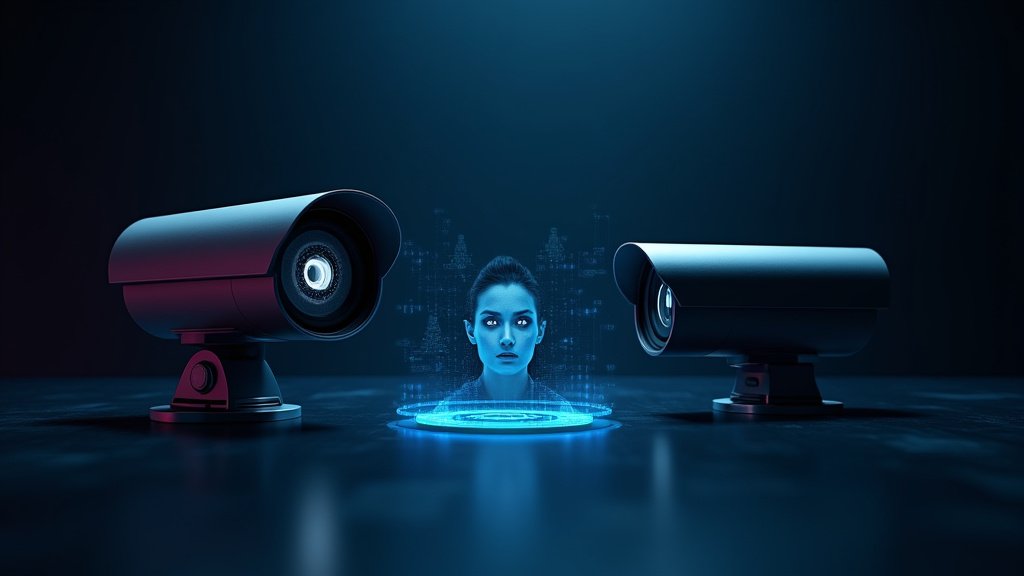
Governments worldwide are grappling with the escalating capabilities of artificial intelligence, sparking debates about privacy, surveillance, and the potential for misuse. As AI systems become more sophisticated, concerns are mounting over their integration into state security apparatuses and the implications for civil liberties. The rapid advancement of AI-powered surveillance tools, from facial recognition to predictive policing algorithms, raises profound ethical questions about the balance between security and individual freedoms. Experts warn that without robust regulatory frameworks and public oversight, the unchecked expansion of AI in surveillance could lead to a dystopian future where every citizen’s activity is monitored and analyzed.
Key Highlights:
- AI’s increasing role in government surveillance is a growing global concern.
- Ethical debates center on the balance between national security and civil liberties.
- The potential for AI misuse in surveillance necessitates strong regulatory oversight.
- Predictive policing and facial recognition are key areas of AI application in security.
- International cooperation is crucial for establishing ethical AI surveillance standards.
The AI Surveillance Nexus
The rapid proliferation of Artificial Intelligence (AI) has ushered in an era of unprecedented technological advancement, with profound implications for governance and societal structures. Nowhere is this more evident than in the burgeoning field of state surveillance. Governments, driven by the perceived need for enhanced security and the desire for greater control, are increasingly turning to AI-powered technologies to monitor populations, predict threats, and enforce laws. This shift, however, is not without its critics and has ignited a fierce debate among policymakers, technologists, and civil rights advocates about the ethical boundaries of such practices.
The Rise of AI-Powered Monitoring Tools
AI’s ability to process vast amounts of data at speeds far exceeding human capacity has made it an attractive tool for intelligence agencies and law enforcement. Facial recognition technology, for instance, can identify individuals in crowded public spaces by comparing faces against watchlists. Predictive policing algorithms aim to forecast where and when crimes are likely to occur, allowing for pre-emptive resource allocation. Furthermore, AI can analyze communication patterns, social media activity, and even biometric data to flag potential security risks. The sophistication of these tools means that surveillance is no longer limited to overt monitoring but can extend into analyzing digital footprints and inferring behavior.
Ethical Quandaries and Civil Liberties
The expanding reach of AI surveillance presents a complex web of ethical challenges. Foremost among these is the erosion of privacy. In societies where AI systems are pervasive, the expectation of privacy in public and even private spaces diminishes significantly. The potential for these systems to be used for mass surveillance, rather than targeted investigations, raises the specter of a surveillance state where dissent can be easily identified and suppressed. Moreover, concerns about algorithmic bias are paramount. AI systems are trained on data, and if that data reflects existing societal biases, the AI can perpetuate and even amplify discrimination against certain demographic groups. This can lead to unfair targeting, wrongful accusations, and a deepening of social inequalities.
The ‘Black Box’ Problem and Accountability
Another significant challenge is the opacity of many AI systems, often referred to as the ‘black box’ problem. It can be difficult, even for experts, to understand precisely how an AI arrives at a particular decision or prediction. This lack of transparency makes accountability challenging. When an AI system makes an error – wrongly identifying an innocent person or falsely predicting a crime – it can be hard to pinpoint the cause or assign responsibility. This raises questions about due process and the right to challenge decisions made by algorithms that significantly impact individuals’ lives.
International Perspectives and Regulatory Efforts
Globally, governments are at different stages of adopting and regulating AI in surveillance. Some nations are forging ahead with aggressive deployment, while others are pursuing more cautious approaches, emphasizing ethical guidelines and public consultation. The European Union, for instance, has been at the forefront of developing comprehensive AI regulations, such as the AI Act, which seeks to categorize AI systems based on risk and impose stricter rules on high-risk applications like those used in law enforcement. Conversely, other countries may prioritize national security over privacy concerns, leading to a divergence in global approaches. This international disparity underscores the need for cross-border dialogue and the establishment of shared ethical principles to govern AI surveillance.
The Future of AI and Public Trust
As AI continues to evolve, its role in surveillance will undoubtedly expand. The development of more advanced AI, including generative AI and sophisticated pattern recognition, could offer new capabilities but also new risks. Building and maintaining public trust will be critical for the responsible deployment of these technologies. This requires transparency about how AI systems are used, robust mechanisms for oversight and redress, and a commitment to ensuring that AI serves societal interests rather than undermining fundamental rights. The ongoing dialogue surrounding AI surveillance is not merely a technical or legal discussion; it is a fundamental conversation about the kind of society we wish to live in.
FAQ: People Also Ask
What are the main concerns regarding AI in surveillance?
The primary concerns revolve around the erosion of privacy, the potential for mass surveillance and misuse of data, algorithmic bias leading to discrimination, lack of transparency and accountability in AI decision-making, and the overall impact on civil liberties and democratic freedoms.
How does facial recognition technology work in surveillance?
Facial recognition systems use AI algorithms to identify or verify a person from a digital image or a video frame. They capture facial features, create a template, and compare it against a database of known individuals. This technology can be used for identification in public spaces, border control, and security checks.
What is predictive policing, and what are its criticisms?
Predictive policing uses AI algorithms and historical crime data to forecast where and when crimes are likely to occur, allowing law enforcement to deploy resources proactively. Criticisms include concerns about reinforcing existing biases in policing, leading to over-policing of certain communities, and the potential for self-fulfilling prophecies.
How can AI bias in surveillance be mitigated?
Mitigating AI bias involves using diverse and representative datasets for training AI models, conducting regular audits for bias, implementing fairness metrics, ensuring human oversight in decision-making processes, and developing transparent and explainable AI systems.
What is the role of international cooperation in AI surveillance regulation?
International cooperation is essential for developing global standards and ethical guidelines for AI surveillance, preventing a ‘race to the bottom’ in regulatory standards, sharing best practices, and addressing cross-border implications of AI technologies. It helps ensure that AI is used responsibly and ethically on a global scale.