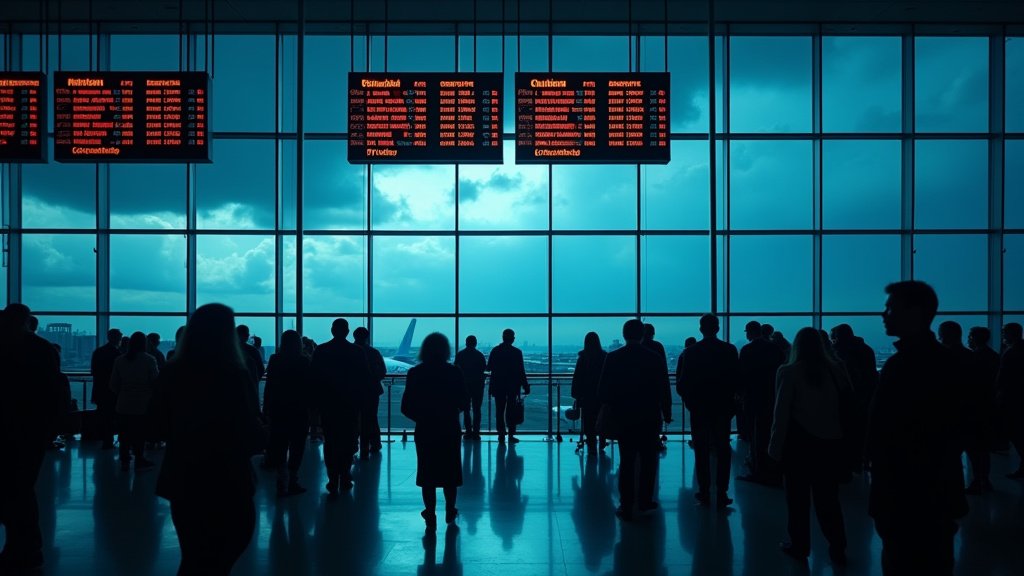
A violent, weather-driven ground stop at Chicago O’Hare International Airport (ORD) has ignited a nationwide aviation emergency, paralyzing air travel across the United States. As of mid-day on April 28, 2026, the cascading effects have resulted in over 5,500 flight delays and hundreds of cancellations, leaving thousands of passengers stranded from the Midwest to the Pacific Coast. The disruption, which originated in the skies over Illinois, has effectively frozen the U.S. air traffic grid, underscoring the fragility of the modern, tightly-wound aviation network.
Key Highlights
- System-Wide Cascade: A severe thunderstorm system triggered a full ground stop at Chicago O’Hare, causing 1,228 delays and 260 cancellations at that hub alone, which then rippled across the country.
- National Impact: More than 5,581 flights nationwide are delayed, with major hubs including Atlanta (ATL), Denver (DEN), Phoenix (PHX), and Boston (BOS) reporting significant backlogs due to diverted and grounded aircraft.
- Recovery Timeline: The Federal Aviation Administration (FAA) and airline analysts anticipate a 24-48 hour recovery window for the national network to return to normalcy.
- Passenger Rights: Major carriers including United, American, and Southwest have issued temporary travel waivers, and travelers are advised to check apps immediately for real-time rebooking options.
The Anatomy of an Aviation Gridlock
The events of April 28, 2026, serve as a stark case study in the “Butterfly Effect” of modern commercial aviation. When a primary hub like Chicago O’Hare—which serves as a critical artery for major carriers—is forced to pause operations, the resulting delay is not additive; it is exponential.
Why Chicago O’Hare is the Domino
Chicago is geographically and operationally central to the U.S. domestic network. When the FAA imposes a ground stop at ORD, it creates an immediate inventory shortage. Aircraft scheduled to depart Chicago for destinations like Seattle or Miami are grounded. Consequently, the aircraft waiting at those destination airports to perform their next leg of the journey cannot arrive in Chicago to pick up new passengers. This forces airline dispatchers to scramble, often leading to a “rolling delay” where a single storm in the Midwest impacts travel plans in Arizona or New England. By mid-morning, the disruption had fully decoupled aircraft from their scheduled crews, forcing airlines to enact emergency rebooking protocols to prevent the system from completely collapsing.
The Role of Infrastructure and Staffing
This incident is not occurring in a vacuum. It follows a volatile month of April 2026, which has seen repeated weather-related system strains. The aviation industry is currently operating at near-maximum capacity, leaving little room for error. When severe weather hits, the buffer—or “slack”—in the system is insufficient to absorb the shock. Analysts have long pointed to the need for modernized air traffic control systems and increased staffing as primary levers to mitigate these cascading failures. Until those systemic upgrades are fully realized, passengers should expect that localized severe weather in a major hub will continue to cause national-level headaches.
Strategies for Navigating the Chaos
For the stranded traveler, the immediate response is critical. Relying solely on airport departure boards is a recipe for frustration, as these systems often lag behind the actual operational reality.
1. Monitor Tail Numbers: If possible, use flight tracking apps to identify the tail number of your specific inbound aircraft. If that plane is currently stuck in Chicago, your flight will inevitably be delayed, regardless of what the departure board says.
2. Proactive Rebooking: Do not wait in the physical line at the gate. If your flight is canceled, use the airline’s mobile app or website to rebook immediately. The first passengers to interact with the digital system get the remaining seats.
3. Understand Your Rights: Under U.S. Department of Transportation (DOT) guidelines, while weather-related delays generally do not mandate financial compensation, you are entitled to rebooking on the next available flight. If the delay is caused by an airline operational issue (crew timing out because of the weather delay), insist on meal vouchers and, for overnight delays, hotel accommodation.
Looking Toward Summer 2026
As we approach the summer travel season, this April 28 event serves as a warning. The volatility of 2026’s spring weather patterns—characterized by high-intensity storm cells and unpredictable atmospheric conditions—is expected to persist. Airline investors, logistical planners, and frequent travelers are adjusting their expectations. The industry is moving toward a model of “resilience planning,” where longer connection windows and spare capacity are being priced into the travel experience. For the average passenger, this means the era of the “tight connection” may be coming to a close; travelers are increasingly advised to treat layovers not as a formality, but as a necessary buffer against an increasingly unpredictable national airspace.
FAQ: People Also Ask
Q: Why does a storm in Chicago affect my flight from Phoenix to Los Angeles?
A: Modern airlines operate on a “hub-and-spoke” model. Your plane likely arrived in Phoenix from Chicago or was scheduled to fly to Chicago next. When the network is tightly connected, a ground stop at one hub prevents the movement of aircraft throughout the entire grid, causing a cascade of delays regardless of weather in your specific departure city.
Q: Should I wait for an automated email or handle rebooking myself?
A: Handle it yourself. Automated rebooking systems often process passengers in batches and may prioritize higher-fare tickets or loyalty program members. Taking initiative via the airline’s app or customer service hotline often yields faster results.
Q: Will I get compensation for this delay?
A: Generally, no. Since the root cause of the disruption is severe weather (an “act of God”), most U.S. carriers are exempt from providing cash compensation. However, they are still obligated to rebook you at no additional cost and, depending on the airline’s specific policy and the length of the delay, may provide vouchers for food and lodging.