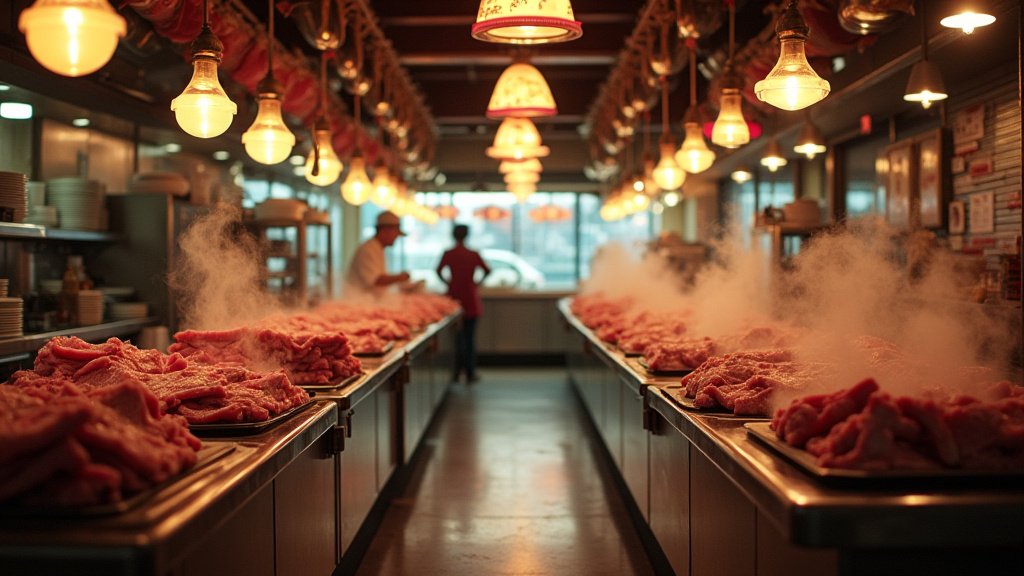
For decades, the culinary compass of the Jewish delicatessen has pointed unerringly toward the Lower East Side of Manhattan. Katz’s Delicatessen, with its iconic neon sign and steam-table theater, has long stood as the non-negotiable benchmark for the perfect pastrami sandwich. However, a surging debate among food critics and deli enthusiasts has reached a fever pitch: the West Coast is no longer just a spectator. At the heart of this culinary tectonic shift is Langer’s Deli in Los Angeles, whose #19 sandwich is increasingly cited as the only true rival to the Katz’s throne. While the East Coast vs. West Coast hip-hop rivalry of the 90s faded, the battle for the title of ‘Pastrami Capital of the United States’ is only intensifying, turning a lunch order into a high-stakes cultural statement.
Key Highlights
- The Contenders: Katz’s Delicatessen (NYC) remains the historic gold standard, while Langer’s Deli (LA) has earned a fierce reputation as the West Coast’s premier challenger.
- The #19 Difference: Langer’s signature #19—pastrami, coleslaw, Swiss cheese, and Russian dressing on double-baked rye—is often cited by critics as the superior construction over the more traditional, meat-heavy Katz’s approach.
- Beyond the Meat: The rivalry isn’t just about the cured beef; it’s a test of bread integrity, mustard sharpness, and the distinct deli atmospheres that define each city’s soul.
- The Cultural Divide: The debate highlights how regional influences—New York’s dense, fast-paced tradition versus Los Angeles’s fusion-friendly, experimental culinary scene—impact our perception of ‘authenticity.’
The Anatomy of an American Icon: A Transatlantic Rivalry
The American Jewish delicatessen is more than just a place to buy lunch; it is an institution of immigrant history, preserved in brine and smoke. When we talk about Katz’s and Langer’s, we aren’t just comparing two sandwiches; we are comparing two distinct philosophies of food preservation and service.
The Science of the Smoke
At the core of this debate is the pastrami itself. True pastrami is a feat of culinary engineering. It begins with the navel cut of the beef, a fatty, flavorful piece of meat that requires a rigorous curing process. The salt cure, the spice rub (typically coriander, black pepper, garlic, and mustard seed), and the long, slow smoke are where the alchemy happens.
Katz’s has long been praised for its deep, smoky flavor profile—a testament to its decades of consistent technique and high turnover, which ensures that the meat never sits long enough to lose its moisture or vibrancy. The meat at Katz’s is notoriously tender, often falling apart under the pressure of the knife, leading to a sandwich that is less of a cohesive unit and more of a glorious, messy pile of meat.
In contrast, Langer’s Deli, located in the Westlake neighborhood of Los Angeles, approaches the meat with a slightly different texture in mind. The Langer’s pastrami is known for being hand-sliced, often slightly thinner, which allows for a more delicate bite. Critics argue that this allows the flavor of the smoke to permeate the meat more evenly, avoiding the occasional stringiness that can plague lesser preparations.
The Bread Dilemma
If the meat is the heart of the sandwich, the bread is its soul—and its structural integrity. This is where the rivalry truly heats up.
The bread served at Katz’s is traditional New York rye: soft, yielding, and designed to absorb the juice of the meat. It serves its purpose, but it is purely a vessel. When you order the classic Katz’s pastrami, you are ordering a heap of meat held together by a couple of slices of bread that will inevitably struggle to contain the payload. It is a sandwich designed for gluttony, and the bread is merely an accessory to the beef.
Langer’s, however, takes the bread factor to another level. The double-baked rye bread at Langer’s is a marvel of its own. It is crusty on the outside but maintains a chewiness that provides a necessary textural contrast to the buttery tenderness of the hot pastrami. This is the crucial design feature of the famous #19; the bread can actually hold the sandwich together through the final bite. This is not just a sandwich; it is an engineered experience.
Cultural Context and Economic Impact
The resurgence of interest in these historic institutions speaks to a larger trend in American dining: the search for ‘authentic’ experiences in an era of homogenization. As corporate chains dilute regional food cultures, the survival of delis like Langer’s and Katz’s becomes a matter of cultural preservation.
Economic factors play a massive role as well. The cost of running a world-class deli is astronomical. Prime brisket prices fluctuate, labor costs in major metros like NYC and LA are at an all-time high, and the rent in neighborhoods like the Lower East Side or Westlake is predatory. Yet, these institutions endure, often serving as the anchor of their respective neighborhoods.
When we analyze the ‘Katz’s vs. Langer’s’ debate, we are also looking at the economic resilience of the classic deli model. Katz’s has turned its reputation into a global brand, attracting tourists from every corner of the earth. Langer’s, while famous, retains a more localized, neighborhood-centric feel. This creates a fascinating dynamic: one is an essential destination for the global culinary traveler, while the other is a vital, beating heart of the LA local scene.
The Future of the Deli Experience
What does the future hold for these legends? We are seeing a move toward ‘New Deli’ culture, where younger chefs are reinterpreting the classics with higher-quality ingredients (grass-fed beef, house-made ferments, localized grains). However, both Katz’s and Langer’s remain steadfast in their traditional methods.
Is there room for both? Absolutely. The rivalry, if we can call it that, is healthy. It forces us to appreciate the nuance of what makes a great sandwich. It prevents complacency. For the consumer, this rivalry ensures that the standard for pastrami in America remains sky-high.
Ultimately, declaring a winner is a fool’s errand. One can argue that Katz’s is the better ‘experience’ because of its storied walls, the history of the neighborhood, and the sheer volume of meat. One can just as easily argue that Langer’s is the ‘better sandwich’ because of the structural integrity of the bread and the refinement of the meat’s texture.
What matters is that these two establishments stand as bastions of a fading art form. Whether you find yourself in the shadow of the Williamsburg Bridge or the bustling streets of MacArthur Park, the pursuit of the perfect pastrami remains one of the great joys of American food culture.
FAQ: People Also Ask
1. Is Langer’s Deli truly better than Katz’s?
‘Better’ is subjective and depends on your preference. If you prioritize raw volume, historic atmosphere, and that classic NYC ‘greasy spoon’ feel, Katz’s is the winner. If you value structural integrity, a more refined flavor profile, and a more user-friendly sandwich construction, Langer’s is likely your choice.
2. What makes the #19 at Langer’s so special?
The #19 is a calculated masterpiece: hand-cut hot pastrami paired with coleslaw, Swiss cheese, and Russian dressing, all served on double-baked rye bread. The coleslaw and dressing cut through the fat of the pastrami, while the double-baked bread prevents the sandwich from falling apart.
3. Does Katz’s Deli deliver nationwide?
Yes, Katz’s Delicatessen is famous for its nationwide shipping, allowing people across the country to experience their signature pastrami, brisket, and corned beef without traveling to New York City.
4. Which deli is more expensive?
Both are considered premium dining experiences relative to standard lunch fare. Prices fluctuate based on market meat costs, but both are often priced in the $25-$30+ range for a premium sandwich. The ‘experience’ cost at Katz’s can feel higher due to travel and wait times.