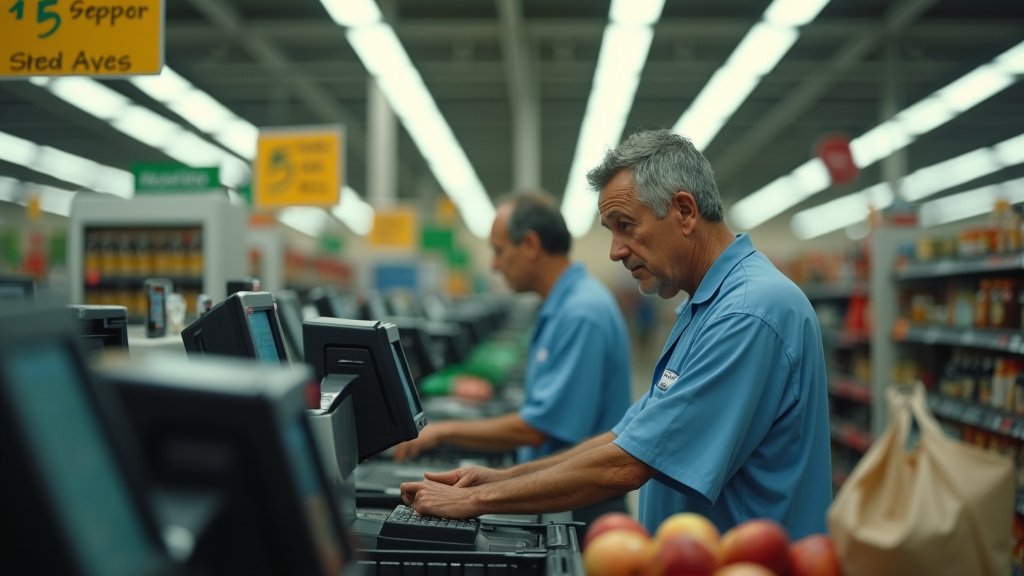
California lawmakers are once again grappling with legislation that could significantly alter the landscape of grocery shopping, potentially leading to increased costs for consumers. Senate Bill 442 (SB 442), championed by Senator Lola Smallwood-Cuevas, aims to enhance worker safety and customer service by imposing new regulations on self-checkout stations. However, the state’s powerful grocery industry warns that these measures will inevitably translate into higher grocery prices.
The Core of Senate Bill 442
At the heart of SB 442 is a series of mandates designed to improve the self-checkout experience and protect retail workers. The bill requires grocery and drug stores to maintain at least one traditional, staffed checkout lane at all times when self-checkout options are available. Furthermore, it stipulates that stores must dedicate one employee to oversee self-checkout areas, with that employee being relieved of all other duties. This designated staff member would be responsible for assisting customers and monitoring the self-service kiosks, with a proposed ratio of one employee for every two self-checkout machines.
The legislation also seeks to streamline the self-checkout process by implementing an item limit, suggesting signs indicating that customers should limit their transactions to 15 items or fewer. While stores would not be penalized for failing to strictly enforce this limit, proponents argue that the signage will encourage self-policing. Critically, SB 442 would also prohibit the sale of items requiring age verification, such as alcohol and tobacco, or those secured with special theft-deterrent devices, at self-checkout stations. Stores looking to implement new technology that impacts job functions would also need to provide advance notification to employees and conduct an assessment of potential impacts.
Proponents Champion Worker Safety and Reduced Theft
Supporters of SB 442, including labor unions like the United Food and Commercial Workers (UFCW) and the California Labor Federation, argue that the bill is essential for protecting the state’s retail workforce. Senator Smallwood-Cuevas has stated that the legislation is about ensuring workers are safe and customers receive the level of service they expect and deserve. Proponents also contend that increased staffing and oversight at self-checkout areas can help curb rampant retail theft, which they claim is exacerbated by understaffed or unmonitored kiosks.
They point to a previous, similar bill (SB 1446) that failed last year, noting that the current proposal is a scaled-back version. The argument from this side is that automation has led to workers being overburdened, managing multiple machines while also handling customer issues and theft concerns, creating an unsafe environment.
Industry Warns of Rising Grocery Bills
Conversely, the California Grocers Association (CGA), the California Retailers Association, and the California Chamber of Commerce have voiced strong opposition. Their primary concern is the increased operational costs associated with hiring more staff to monitor self-checkout lanes. Daniel Conway, a lobbyist for the CGA, has argued that these added labor expenses will inevitably be passed on to consumers, contributing to California’s already high grocery prices. He suggests that self-checkout, despite its potential for misuse, is often a more efficient option for customers, particularly for those with small purchases.
Industry groups also express skepticism about the effectiveness of the item limit and the overall necessity of the proposed regulations, suggesting that the bill is more about mandating staffing levels than genuinely improving the shopping experience or reducing theft. They also raise concerns about the potential for a patchwork of local ordinances if a uniform statewide standard isn’t established.
As a potential compromise, grocers have suggested allowing alcohol sales at self-checkout stations to help offset increased costs. However, Senator Smallwood-Cuevas has rejected this proposal, citing risks to community safety, particularly for young people. California is currently the only state that completely bans alcohol sales at self-checkout.
Legislative Journey and Future Outlook
SB 442 has advanced through several legislative stages, passing the state Senate and moving through Assembly committees. The bill reflects an ongoing debate in the state concerning the balance between technological advancement, worker rights, and consumer affordability. While proponents see it as a common-sense measure to support workers and improve retail environments, opponents foresee increased financial burdens for both businesses and shoppers.
The outcome of SB 442 remains uncertain as it navigates the remaining legislative hurdles. Lawmakers face the challenge of weighing the demands for enhanced worker protections and reduced theft against the industry’s warnings of escalating grocery prices, leaving consumers to watch closely as decisions that could impact their weekly shopping budgets are made.