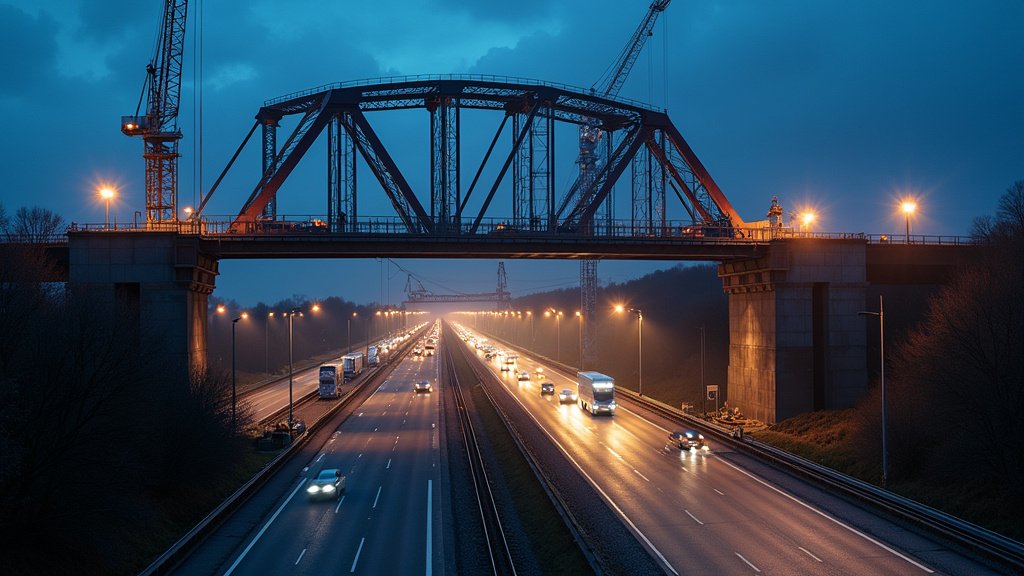
The West Coast Main Line has fully reopened, marking the end of significant journey improvement projects on this vital transport artery. Passenger services resumed on January 15, 2026, following intensive work that involved complex engineering focused on crucial sections of the West Coast Main Line. This extensive upgrade project, a significant Network Rail project, spanned two weeks and was one of the largest undertaken recently, focusing on the West Coast Main Line.
A New Era for the West Coast Main Line
The core of the work involved a major engineering feat: replacing a major bridge. This was the Clifton Railway Bridge, which crosses the M6 motorway near Penrith. The old bridge, a 4,200-tonne structure measuring 130 meters in length, was demolished by engineers who then installed a new, modern one. This significant bridge replacement had a cost of £60 million and was a crucial step in the ongoing railway upgrades for the West Coast Main Line.
Simultaneous Upgrades Across the West Coast Main Line
The bridge replacement necessitated significant closures, affecting both the West Coast Main Line and the M6 for two weeks. This closure provided an unprecedented opportunity for Network Rail teams to tackle multiple projects simultaneously. These vital upgrades were carried out between Preston and the Scottish border, effectively preventing future, separate disruptions and proving more cost-effective for the overall transport infrastructure enhancements.
Carlisle Signalling Modernization on the West Coast Main Line
A key upgrade was the signalling modernization in Carlisle. This £61 million project updated old technology, with the old systems dating back to the 1960s. New digital systems now improve train reliability. The Kingmoor resignalling project included new LED signals and advanced train detection systems, representing a “once-in-a-generation” event that ushers in a new era for train traffic control on the West Coast Main Line.
Overhead Lines and Rockfall Protection along the West Coast Main Line
Further improvements included the replacement of nearly 70 kilometers of overhead lines, which power trains through Shap and Tebay. Additionally, rockfall protection was installed through Shap cutting. New signalling gantries and signals were added at Preston station, alongside more than 60 smaller upgrades contributing to the overall railway upgrades for the West Coast Main Line.
The Impact and Future of the West Coast Main Line
These extensive works promise significant benefits, with passengers and freight operators set to experience improved train reliability. The West Coast Main Line is a crucial route, linking major cities like London, Glasgow, and Birmingham. Modernization efforts on this line have historical precedent, with past upgrades bringing faster journeys and increased capacity. Furthermore, these improvements help reduce road congestion and contribute to lower carbon emissions, reinforcing the importance of this transport infrastructure.
The project involved close collaboration between Network Rail, Skanska, and Siemens Mobility, with input from train operators like Avanti West Coast and TransPennine Express to manage disruption effectively. During the closure, the Settle to Carlisle line served as a diversionary route, the first time in a decade this had been utilized, highlighting the scale of the Network Rail project on the West Coast Main Line.
Network Rail stated that these upgrades represent a major impact, ensuring a more reliable railway for generations. This comprehensive approach safeguards a vital national transport link, ensuring its continued service for passengers and freight. This development is essential news for the West Coast Main Line corridor and its continued role as a cornerstone of the UK’s transport infrastructure.
Editorial Notes on the West Coast Main Line Project
The West Coast Main Line‘s history is characterized by continuous upgrades. Previous modernisations in the 1960s and 1970s laid essential groundwork. The large-scale West Coast Route Modernisation (WCRM) project from 1999 to 2008, despite its cost and challenges, delivered key benefits including shorter journey times and substantial increases in capacity, setting a precedent for future railway upgrades on the West Coast Main Line.
Ongoing enhancements continue into the 2020s, aiming to advance digital signalling and track strength. The line remains a critical artery supporting economic growth. This recent investment secures its future, ensuring efficiency and reliability. This development is vital news for the country’s national transport infrastructure and the continued operational success of the West Coast Main Line.