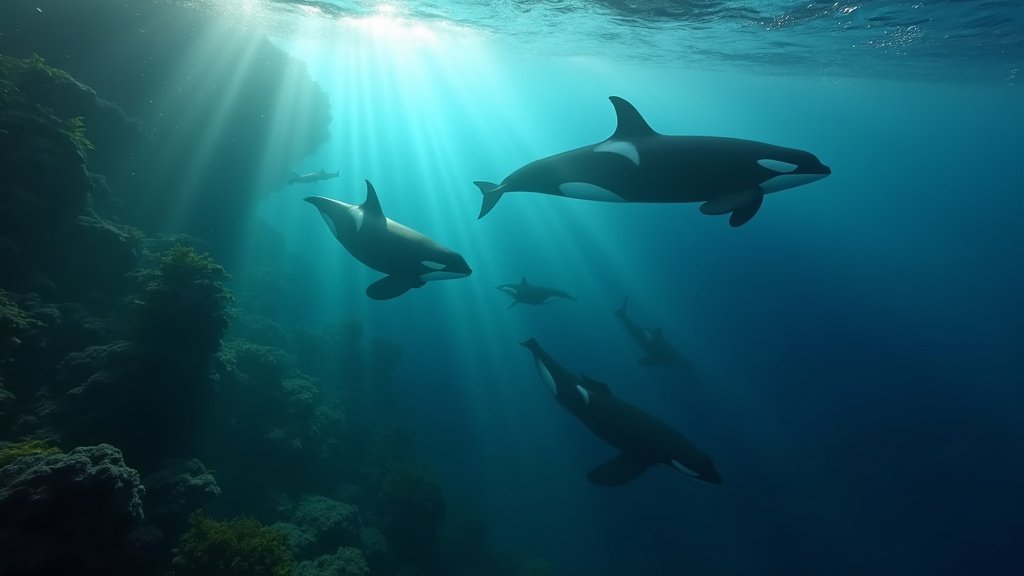
Groundbreaking current research has unveiled a significant and previously hidden schism within the **West Coast Killer Whales** population, revealing two distinct subpopulations with vastly different lifestyles and ecological roles. This pivotal discovery, published in the journal PLOS One, challenges long-held assumptions and underscores the urgent need for tailored conservation strategies along the Pacific coast for **West Coast Killer Whales**.
For years, scientists operated under the assumption that transient killer whales, known for their mammal-hunting prowess, represented a largely cohesive unit across the West Coast, ranging from British Columbia to California. However, new investigations, compiled over 16 years of meticulous data collection involving more than 2,200 documented encounters, have redrawn the social and ecological map of these apex predators. The findings definitively split these orcas into two socially and geographically independent groups: the inner-coast transients and the outer-coast transients, highlighting the complexity of **West Coast Killer Whales**.
The Two Worlds of West Coast Killer Whales
This new scientific news highlights a profound east-west divide rather than a previously suspected north-south one. The inner-coast subpopulation, estimated at around 350 individuals, primarily inhabits the nearshore inlets, bays, and sheltered waterways, often staying within six kilometers of land. These **West Coast Killer Whales** navigate complex, maze-like environments, akin to “city dwellers” expertly maneuvering through busy urban landscapes. In stark contrast, the outer-coast subpopulation, numbering approximately 210 individuals, are the “backcountry dwellers” of the marine world. They roam the deeper offshore waters along the continental shelf-break and slopes, frequently venturing up to 120 kilometers from shore and patrolling areas near deep submarine canyons. Understanding these **coastal orca pods** is crucial.
Divergent Lifestyles: Prey and Habitat Define the Divide for West Coast Killer Whales
The most striking differences between these two groups lie in their dietary habits and hunting grounds. Inner-coast transients typically hunt smaller marine mammals, focusing on prey like harbor seals and harbor porpoises that frequent shallower, coastal waters. They tend to travel and forage in smaller, tight-knit pods of about five individuals, showcasing distinct **orca hunting behavior**. In contrast, their outer-coast counterparts are specialists in targeting larger, more formidable prey. Their diet includes animals such as California sea lions, northern elephant seals, Pacific white-sided dolphins, and even young gray whale calves. These hunts often occur in larger groups, averaging nine individuals, and require different tactics suited for the open ocean, further differentiating these **orca subpopulations**.
Rare Encounters and Orca Social Dynamics
Despite their shared broad range along the Pacific coast, interactions between the inner-coast and outer-coast **West Coast Killer Whales** are exceedingly rare. Social network analysis, which researchers described as creating “friendship maps,” revealed that these two communities mingle in less than one percent of documented encounters. In the few instances where they have been observed together, particularly outer-coast males have exhibited aggressive behaviors towards inner-coast whales, including slapping their dorsal fins and charging. This limited interaction strongly suggests they function as distinct social entities with their own established routines and territories, impacting **orca social dynamics**.
Roots of the Divide: Evolution and Human Impact on West Coast Killer Whales
The reasons behind this significant divergence are multifaceted, likely stemming from a combination of habitat specialization, distinct prey availability, and the enduring impact of human activities. Historical factors such as seal culls and marine mammal harvests may have influenced prey distribution and availability, potentially reinforcing the separation and specialization of these two groups of **West Coast Killer Whales** over time. Researchers suspect that the vast and challenging nature of the offshore Pacific may also contribute to the distinct adaptations seen in the outer-coast population, influencing **marine mammal conservation**.
Conservation Imperatives: A Tailored Approach for West Coast Killer Whales
The confirmation of these two distinct subpopulations carries profound implications for marine mammal conservation efforts. Dr. Andrew Trites, a co-author of the study, emphasized that “these two communities of transient killer whale inhabit very different worlds and lead distinctly different lives.” Consequently, a “one-size-fits-all” approach to conservation will not suffice. Each subpopulation requires carefully tailored management plans that reflect their unique needs, ecological roles, and the specific threats they face in their respective habitats. Understanding these nuances is critical for effective protection and long-term survival of **West Coast Killer Whales** and informs the ongoing **killer whale research**.
Ongoing Investigations and Future Directions in West Coast Killer Whale Research
This extensive research, spearheaded by Josh McInnes from the University of British Columbia’s Institute for the Oceans and Fisheries, relied on sophisticated social network and geospatial analysis of decades of photographic identification data for **Pacific coast orcas**. While this study has revealed a significant divide among **West Coast Killer Whales**, scientists acknowledge that the ocean still holds many secrets. The vastness of the offshore Pacific means there may be even more subpopulations yet to be discovered. Future investigations will likely focus on genetic analyses, finer-scale behavioral studies, and the long-term monitoring of prey dynamics to further elucidate the complex lives of these intelligent marine mammals and inform robust conservation strategies for **transient killer whales**.