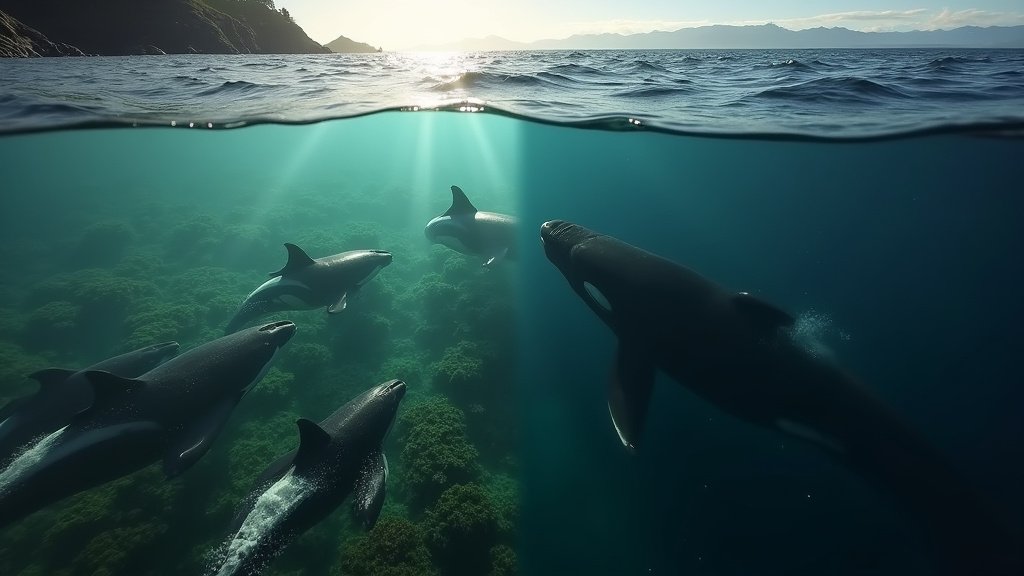
A comprehensive new study has unveiled a significant division within the mammal-eating killer whale populations along the West Coast of North America, revealing two distinct communities of **West Coast Killer Whales** that largely keep to themselves. The research, published on November 6, 2025, in the journal PLOS One, suggests these groups, dubbed “inner coast transients” and “outer coast transients,” maintain separate habitats, diets, and social behaviors, challenging previous assumptions about their population structure.
Decades of Research Uncover a Hidden Divide in West Coast Killer Whales
For lead author Josh McInnes, a founder of the Oceanic Research Alliance and an MSc candidate at the University of British Columbia’s Institute for the Oceans and Fisheries (IOF), these findings represent the culmination of nearly two decades of dedicated observation and data collection for this **killer whale study**. The study analyzed over 2,200 individual killer whale encounters documented along the West Coast, stretching from British Columbia down to California. This extensive investigation found that instead of a single, loosely structured population, these **mammal-hunting orcas** are segregated along an east-west divide, rather than a previously suspected north-south one, impacting **West Coast orcas**.
Inner Coast vs. Outer Coast: Two Ways of Life for West Coast Killer Whales
The research highlights stark differences in the lifestyles of these two **West Coast Killer Whales** communities. The “inner coast transients” are described as “city dwellers,” adept at navigating the complex network of inlets, bays, and sheltered waterways close to shore. Their primary food sources consist of smaller marine mammals like harbor seals and porpoises, illustrating specific **marine mammal diets**. These whales are typically observed within approximately six kilometers of land and in shallower waters, often numbering around 350 individuals.
In contrast, the “outer coast transients” are characterized as “rural dwellers.” They spend much of their time further offshore, venturing hundreds of kilometers out to sea and hunting in deep canyons along the continental shelf break. Their diet is considerably different, often including larger prey such as dolphins, elephant seals, and even juvenile grey whales, showcasing diverse **marine mammal diets**. These outer coast **West Coast Killer Whales**, thought to be more robustly built for tackling larger prey, utilize distinct hunting strategies tailored to their open-ocean environment.
The ‘Why’ Behind the Separation of West Coast Killer Whales
The primary driver for this separation appears to be ecological specialization. McInnes explains that distinct diets lead to behavioral divergence, as whales learn to hunt specific species and consequently associate with other individuals who share those hunting skills. “That becomes a behavioral thing, they learn how to hunt specific species which means they are going to associate with individuals that hunt the same,” McInnes stated. “Therefore, you get this kind of social isolation between the two groups,” affecting **orca social behavior**.
While these two communities of **West Coast Killer Whales** rarely interact, their habitats do converge in certain areas, such as along the California coast where the continental shelf comes closer to land. It is in these transitional zones that researchers have occasionally observed the two groups together.
Implications for West Coast Killer Whale Conservation
Dr. Anna Hall, a marine zoologist with Sea View Marine Sciences, noted that the findings are not surprising given the complexity of these apex predators. “We know that they know how to make the best use of their environment by not competing with each other,” she commented, offering insights into **coastal whale populations**. The study’s revelations carry significant weight for **killer whale conservation** efforts. “These two communities of transient killer whale inhabit very different worlds and lead distinctly different lives,” said Dr. Andrew Trites, a co-author and professor at UBC. “Protecting them will take more than a one-size-fits-all approach. Each needs a tailored plan that reflects their unique needs and the specific threats they face.”
This detailed understanding of habitat use and ecological specialization is crucial for developing effective management and **killer whale conservation** strategies for these iconic **West Coast Killer Whales**. The research also hints at the possibility of an additional, more elusive “oceanic” transient population, suggesting that the full diversity of these intelligent predators may still hold further secrets. This news from the West Coast offers a crucial update to our understanding of these magnificent creatures and the unique challenges faced by **transient killer whales**.