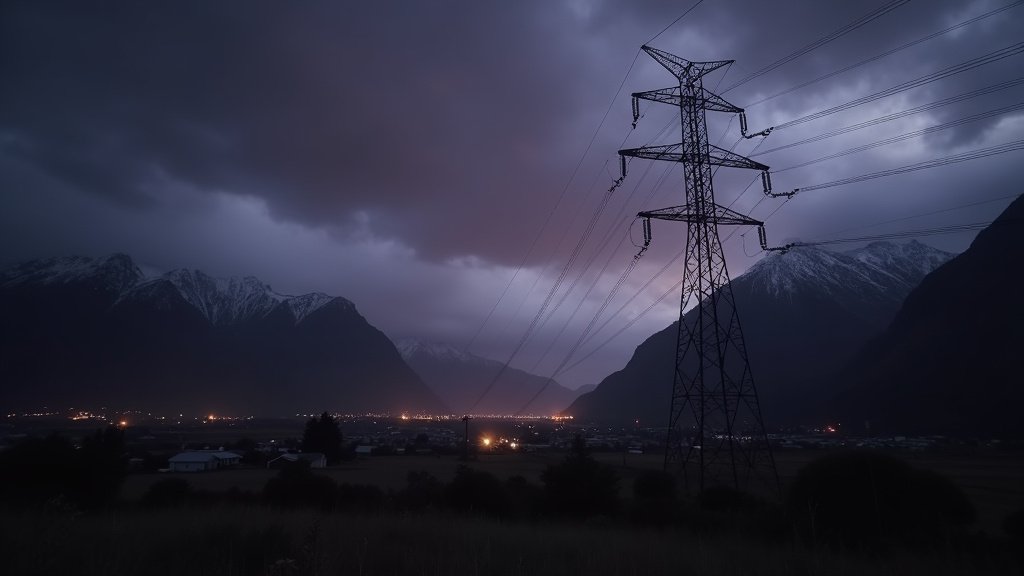
Wellington, NZ – October 23, 2025 – Significant portions of the top half of New Zealand’s South Island and the entire West Coast experienced widespread power outages on Wednesday, October 22, 2025, following severe weather that caused critical faults on the national electricity grid. The disruption affected tens of thousands of households and businesses, leading to traffic light failures and prompting urgent advisories from energy providers and emergency services.
Extent of the Power Disruption
The severe weather event, characterized by strong and damaging winds, triggered multiple failures within Transpower’s national grid, impacting a vast geographical area. Reports indicated that approximately 90,000 households were believed to be without power at the peak of the outage. Specific areas affected included Nelson, Tasman, Marlborough, and extended down the West Coast, encompassing towns like Greymouth, Hokitika, Reefton, and Murchison. Further south, communities such as Kaikoura and Culverden also faced significant disruptions, with Marlborough Lines reporting around 26,400 homes impacted in its service area alone. Westpower confirmed that over 9,000 households on the West Coast were affected by multiple outages across its network.
Cause and Key Players
Transpower, the owner and operator of New Zealand’s national electricity grid, identified severe weather as the primary cause of the faults. High winds battered the region, leading to the tripping of three major transmission circuits that supply the upper South Island. Investigations were immediately launched by Transpower’s teams to identify the precise nature of the faults and to develop restoration plans. Local lines companies, including Marlborough Lines, Network Tasman, Westpower, and MainPower (which services areas like Hanmer Springs and Culverden), worked in coordination with Transpower, facing the challenge of restoring power to their respective networks once the national grid supply was stabilized.
Restoration Efforts and Timelines
As of Thursday morning, October 23, 2025, restoration efforts were well underway. Transpower confirmed that power had been successfully restored to several key areas, including Kaikoura and Culverden, as well as Greymouth, Stoke, and Blenheim, reconnecting them to the national grid. Local lines companies then took over the process of supplying power to individual customer networks in these reconnected areas. Initially, Transpower projected that remaining power should be fully restored by midday on Wednesday, October 22, assuming no further network issues. However, ongoing weather warnings meant that further outages remained a possibility, and restoration was described as a staged process.
Impact on Communities and Advisories
The widespread power outage had immediate and tangible effects on affected communities. Traffic lights across Nelson and Tasman went dark, leading authorities to urge motorists to exercise extreme caution and treat all intersections as stop signs. On the West Coast, emergency management officials warned that cell towers might begin to lose power as their backup battery systems depleted. Given the difficult weather conditions hampering repair crews, the possibility of prolonged outages was raised, and residents were advised to limit non-essential cellphone use to text messages to conserve battery life. Energy providers and Transpower emphasized the importance of checking local retailer and lines company websites for the most up-to-date and detailed outage information specific to individual areas.
Broader Weather Context
The power failures occurred amidst severe weather warnings and watches across much of the South Island. Marlborough was under an orange strong wind warning, with expected gusts of up to 130 km/h. Nelson, Tasman, and parts of the West Coast were under a strong wind watch. Red level strong wind warnings were also in effect for parts of the Canterbury High Country, Marlborough, Wellington, and Wairarapa, with recorded gusts exceeding 200 km/h in exposed high-country areas. MetService forecasts indicated that these conditions posed risks not only to power infrastructure but also to trees, roofs, and driving safety, leading to advice for residents to stay indoors or seek sturdy shelter.
Looking Ahead
While significant progress has been made in restoring power, the volatile weather situation means that vigilance is still required. Transpower and local network operators continue to monitor the grid and work towards full restoration, prioritizing crew safety in the challenging conditions. Residents in affected regions are advised to stay informed through official channels and to prepare for potential further disruptions as the severe weather system moves through the country. This significant power disruption serves as a stark reminder of the vulnerability of critical infrastructure to extreme weather events and the importance of resilient energy networks.