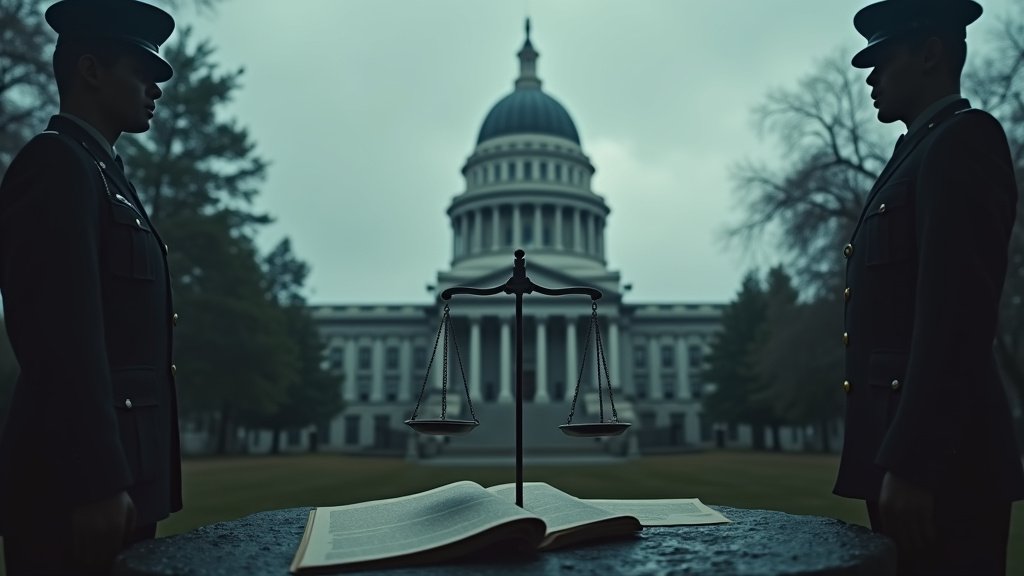
Oregon Joins City in Legal Battle Against Federalization of National Guard Amidst Protests
PORTLAND, OR – In a significant legal challenge to federal authority, the state of Oregon and the City of Portland have jointly filed a lawsuit seeking to halt President Donald Trump’s order to deploy 200 members of the Oregon National Guard for federal functions in Portland. The lawsuit, filed on Sunday, September 28, 2025, argues that the deployment is an “unlawful federalization” and an “overreach” of presidential power, aimed at quelling protests outside a federal immigration facility.
Legal Challenge Filed Against Federal Overreach
The legal action was announced by Oregon Attorney General Dan Rayfield, who stated that the deployment order, received by Governor Tina Kotek from Secretary of Defense Pete Hegseth, lacks legal justification. The lawsuit contends that federal law permits the federalization of the National Guard only in extreme circumstances such as invasion, rebellion, or when federal laws cannot otherwise be enforced—conditions that Oregon officials argue are not present in the state.
“Oregon communities are stable, and our local officials have been clear: we have the capacity to manage public safety without federal interference,” Rayfield declared. “What we’re seeing is not about public safety, it’s about the President flexing political muscle under the guise of law and order, chasing a media hit at the expense of our community.” The suit specifically cites violations of the 10th Amendment, asserting the infringement of state sovereignty, and potentially the Posse Comitatus Act, which generally prohibits the use of federal military for domestic law enforcement.
Context of Escalating Tensions
President Trump’s directive, announced on Saturday, September 27, followed a period of protests near a U.S. Immigration and Customs Enforcement (ICE) facility in Portland. While federal officials characterized the situation as one requiring federal intervention to protect property and personnel from “domestic terrorists” and “violent riots,” state and city leaders have consistently maintained that the protests have been small-scale and manageable by local law enforcement.
Governor Tina Kotek expressed her disagreement directly to the President, stating that there was “no insurrection or threat to public safety that necessitates military intervention in Portland.” She emphasized that Oregon is capable of handling its own security needs without federal troops, a sentiment echoed by Portland Mayor Keith Wilson, who called the deployment “unnecessary and provocative.”
The deployment order, issued under Title 10 of the U.S. Code, would place 200 members of the Oregon National Guard under federal command for 60 days. This move has been met with broad opposition from Oregon’s Democratic leadership, who view it as a politically motivated tactic rather than a genuine effort to enhance public safety.
Broader Implications on the West Coast and Beyond
This lawsuit is not an isolated incident. The Trump administration has previously deployed federal forces, including the National Guard and federal law enforcement agents, to other West Coast cities and Democratic-led municipalities, such as Los Angeles and Washington, D.C., often sparking similar legal challenges and widespread criticism. California, for instance, had previously filed a lawsuit against the administration regarding the deployment of troops to Los Angeles, arguing it was an illegal encroachment on state and local authority.
The escalation in Portland highlights a broader national debate over the balance of power between federal and state governments, particularly concerning the use of military assets in domestic law enforcement and response to civil unrest. Critics argue that such deployments can inflame tensions, undermine public trust, and set a dangerous precedent for federal overreach.
Arguments and Counterarguments
White House spokesperson Abigail Jackson defended the administration’s actions, stating that President Trump “is using his lawful authority” to protect federal assets and personnel. Pentagon spokesperson Sean Parnell confirmed that the troops were called “to deter rampant lawlessness within Portland and to enable Federal law-enforcement officers to safely conduct their duties.” However, Oregon officials point to the relative stability and the capability of local law enforcement, arguing that the federal presence is precisely what threatens to escalate tensions and create the very unrest the administration claims to be addressing.
The lawsuit seeks immediate relief from the court, asking for the federalization order to be declared unlawful and for any such deployment to be halted. The legal battle is expected to have significant implications for federal-state relations and the interpretation of presidential authority in domestic matters, particularly for cities on the West Coast facing similar federal scrutiny. This developing news story underscores the ongoing friction between the federal government and certain states over issues of law enforcement and public order.
Unfolding Situation
As the legal proceedings begin, Oregon and Portland officials remain resolute in their stance against what they perceive as an unconstitutional and politically motivated use of federal power. The outcome of this lawsuit could set a critical precedent for how future federal-state disputes over national guard deployments and domestic law enforcement are handled across the United States. The nation watches closely for further developments in this top West Coast news story.