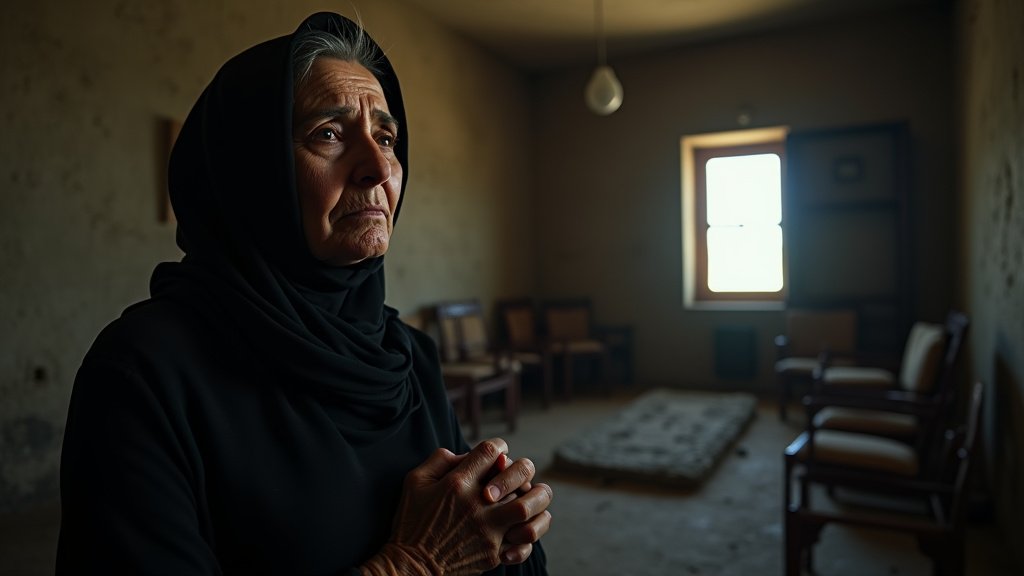
In the Balata refugee camp, nestled in the occupied West Bank, Jameela Sanaqra lives a vigil of unimaginable pain. Her youngest son, Mahmoud, was shot in his bedroom by Israeli commandos on February 27th, just days before his 26th birthday. Soldiers then took his body, leaving Jameela in a state of suspended grief, waiting for the return of her son so she can finally bury him. Mahmoud’s story is not an isolated incident but a tragic illustration of a deeply entrenched Israeli policy that rights groups condemn as a weapon of war: the systematic withholding of Palestinian bodies. This practice denies grieving families closure, inflicts profound emotional distress, and violates fundamental human dignity.
The Lingering Grief of Jameela Sanaqra
Mahmoud Sanaqra’s death has plunged his mother, Jameela, into a profound agony compounded by uncertainty. After Israeli soldiers stormed her home, shot Mahmoud in his bedroom, and then confiscated his body, Jameela does not even know for certain if her son is dead or alive. The family has already prepared an empty grave for Mahmoud in their local cemetery, a stark testament to their loss, nestled beside the resting places of his brothers, Ahmad and Ibrahim, who were also killed. Jameela’s pain is palpable, describing her mind as “scattered” and a fire within her that can only be extinguished by burying Mahmoud next to his siblings. The Israeli military did not respond to Al Jazeera’s request for comment regarding Mahmoud’s case.
A Systemic Policy: Israel’s Withholding of Palestinian Bodies
Mahmoud’s plight is representative of a broader, ongoing issue. According to the Palestinian National Campaign for the Recovery of Martyrs’ Bodies, Mahmoud may be among over 2,220 Palestinians whose bodies are held by Israel. Data from human rights organizations paints a grim picture: as of May 2025, the Jerusalem Legal Aid and Human Rights Center (JLAC) estimated that Israeli authorities were withholding the bodies of 668 Palestinians. Among these are the remains of children, prisoners, and women, with some bodies held for decades. The practice has been described as a form of ‘necropolitics’—the politics of death—where authorities wield power over life and the finality of death.
These withheld bodies are often kept in morgues or buried in unmarked “cemeteries of numbers,” identifiable only by numbered placards. Organizations like JLAC and Adalah – The Legal Centre for Arab Minority Rights in Israel have been at the forefront of investigations and legal challenges against this policy. The current news cycle often highlights these ongoing human rights concerns in the West Bank and Gaza.
The Human Cost: Denial of Dignity and Closure
The ramifications of withholding bodies extend far beyond the initial loss. Rights groups emphasize that this practice inflicts immense suffering by denying families the right to bury their loved ones with dignity, according to their religious and cultural customs. Burial is often described as the “final act of love” and the essential closure needed to process grief. By preventing this, Israel inflicts “unbearable pain” and “massive collective punishment” upon families, who are robbed of their fundamental right to mourn and remember. For families like Jameela’s, the inability to perform burial rituals constitutes a desecration and a prolonged torture.
Legal Battles and International Scrutiny
Israel’s policy of withholding bodies has faced numerous legal challenges and international condemnation. While the Israeli Supreme Court has issued conflicting rulings—at times recognizing the right to burial, at others upholding the state’s policy for leverage—human rights organizations argue that the practice fundamentally violates international humanitarian and human rights law. The UN Human Rights Committee has expressed concern that this practice “may amount to collective punishment and to torture and ill-treatment.”
Israeli authorities have often justified the withholding of bodies as a deterrent and as leverage in negotiations, particularly for the return of Israelis held by Hamas in Gaza. However, critics argue this instrumentalizes death and dehumanizes Palestinians, turning corpses into bargaining chips. The Jerusalem Legal Aid and Human Rights Center (JLAC) has worked for years to recover these remains, documenting hundreds of cases and filing court petitions.
Broader Context: The Balata Camp and Ongoing Conflict
The Balata refugee camp, located near Nablus, is one of the most densely populated camps in the West Bank and has frequently been the site of Israeli military operations. These incursions often result in clashes, injuries, and deaths, as seen in the ongoing current events in the region. Jameela’s tragedy unfolds against this backdrop of persistent conflict, where every loss carries the added burden of potential denial of final rites.
The enduring practice of withholding bodies underscores a broader pattern of Israeli policy that human rights advocates argue constitutes a systematic extension of colonial domination. It punishes Palestinians not only in life but also in death, denying them dignity and the fundamental human right to lay their loved ones to rest. These ongoing investigations by rights groups aim to shed light on these grave violations and advocate for justice.