Thousands Participate in ‘No Kings’ National Day of Protest Across the US
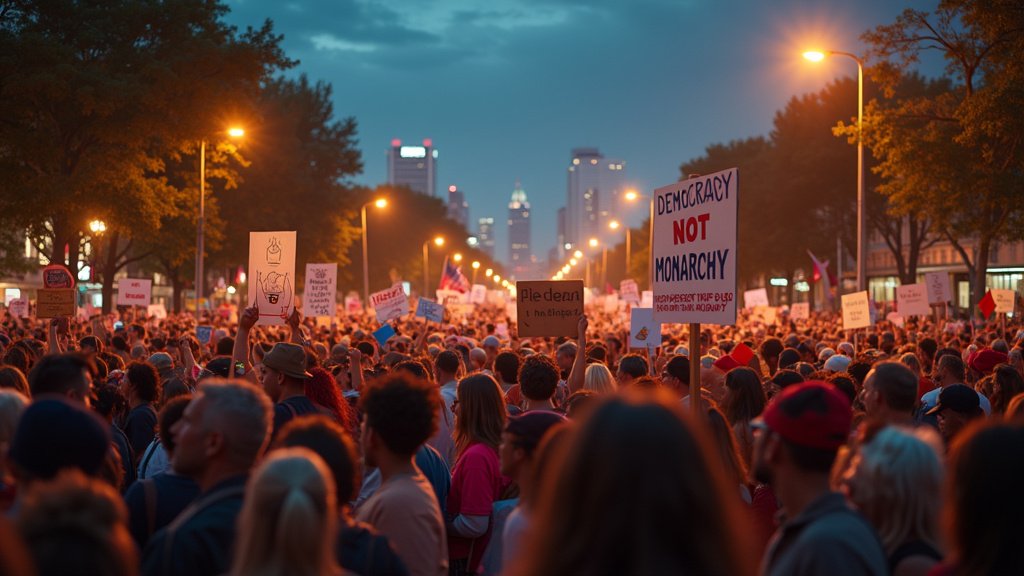
Nationwide — October 19, 2025 — Millions of Americans took to the streets in all 50 states on Saturday for the second major wave of “No Kings” protests, a nationwide demonstration against what organizers and participants describe as the perceived authoritarian tendencies and policy decisions of the current administration. The massive rallies, which spanned from bustling metropolitan centers to smaller towns, underscored a deep-seated concern among a broad spectrum of the public regarding the direction of the country and the state of its democratic institutions.
A Coalition Demands Accountability
The “No Kings” movement, spearheaded by a coalition of progressive and civil rights organizations including the 50501 movement, Indivisible, the ACLU, and MoveOn, aims to send a clear message: that the United States is a republic, not a monarchy. Organizers estimated that nearly seven million people participated in over 2,700 rallies, making it potentially the largest single-day protest in U.S. history. This follows a similar massive turnout in June, solidifying the movement’s significant reach and impact.
The core grievances fueling the protests are multifaceted. Participants voiced strong opposition to aggressive immigration policies, including widespread detentions and the deployment of federal forces in cities. Widespread anger was also directed at significant cuts to federal education and environmental protections, as well as looming healthcare cuts and ongoing government shutdowns. Many signs and chants decried what they viewed as an erosion of democratic norms, a concentration of power, and an attack on civil liberties and free speech. The protests highlighted concerns ranging from the rising cost of living to the perceived corruption and overreach of executive power.
West Coast Sees Robust Participation Amidst National Uprising
The West Coast was a significant hub for the “No Kings” demonstrations. Cities like San Pablo and San Francisco, California, saw substantial participation, with protesters uniting under the “No Kings” banner to voice dissent. In San Diego, police reported over 25,000 attendees at various rallies across the city, with no arrests made. The sheer scale of the events on the West Coast reflects trending national sentiment.
In Fresno, California, thousands gathered for the “No Kings” demonstration. While the protests were largely peaceful, local law enforcement reported issuing citations during the event as officers patrolled the demonstration areas. These current news events underscore the varied local experiences of nationwide movements.
A Spectrum of Dissent: Festive Atmosphere Meets Serious Concerns
The “No Kings” protests were often characterized by a festive and creative atmosphere. Many participants donned colorful and often humorous inflatable costumes – a trend that gained traction during earlier protests in Portland, Oregon, against immigration raids. This playful element, seen in dinosaur, frog, and unicorn costumes, served to highlight the movement’s commitment to peaceful resistance and to counter narratives of disorder. Chants of “This is what democracy looks like” and “No hate, no fear, immigrants are welcome here” echoed through city streets, accompanied by marching bands and the display of American flags.
However, the lighthearted elements were juxtaposed with deeply serious concerns about the nation’s trajectory. In some instances, protests escalated. In Portland, Oregon, law enforcement deployed crowd control measures, including tear gas, following clashes with a smaller group of protesters. In Broadview, Illinois, 15 arrests were made during demonstrations at an ICE facility. These isolated incidents highlight the tension that can arise during large-scale public expressions of dissent.
Official Responses and Political Polarization
President Trump responded to the nationwide protests by asserting, “I’m not a king,” pushing back against the central theme of the demonstrations. Conversely, Republican leaders, including House Speaker Mike Johnson, characterized the “No Kings” rallies as “Hate America” events. This stark contrast in rhetoric underscores the deep political polarization surrounding the protests.
Concerns about government surveillance also surfaced, with groups like the Electronic Frontier Foundation and the American Civil Liberties Union warning about potential monitoring of protesters through facial recognition technology, drones, and mobile phone tracking. Reports also emerged of “fusion centers,” intelligence networks established after 9/11, monitoring protests in cities like Sacramento and Fresno, raising questions about the balance between security and the protection of constitutionally protected dissent.
A Defining Moment for Democracy
The “No Kings” national day of protest stands as a powerful testament to ongoing civic engagement and a collective demand for accountability. By taking to the streets in unprecedented numbers, millions of Americans signaled their commitment to democratic principles, free speech, and the fundamental idea that power resides with the people, not with any single ruler. The scope and diversity of the participants, coupled with the widespread messaging, underscore that these are trending issues resonating across the nation. Future investigations will likely focus on the long-term impact of these widespread demonstrations on policy and political discourse.