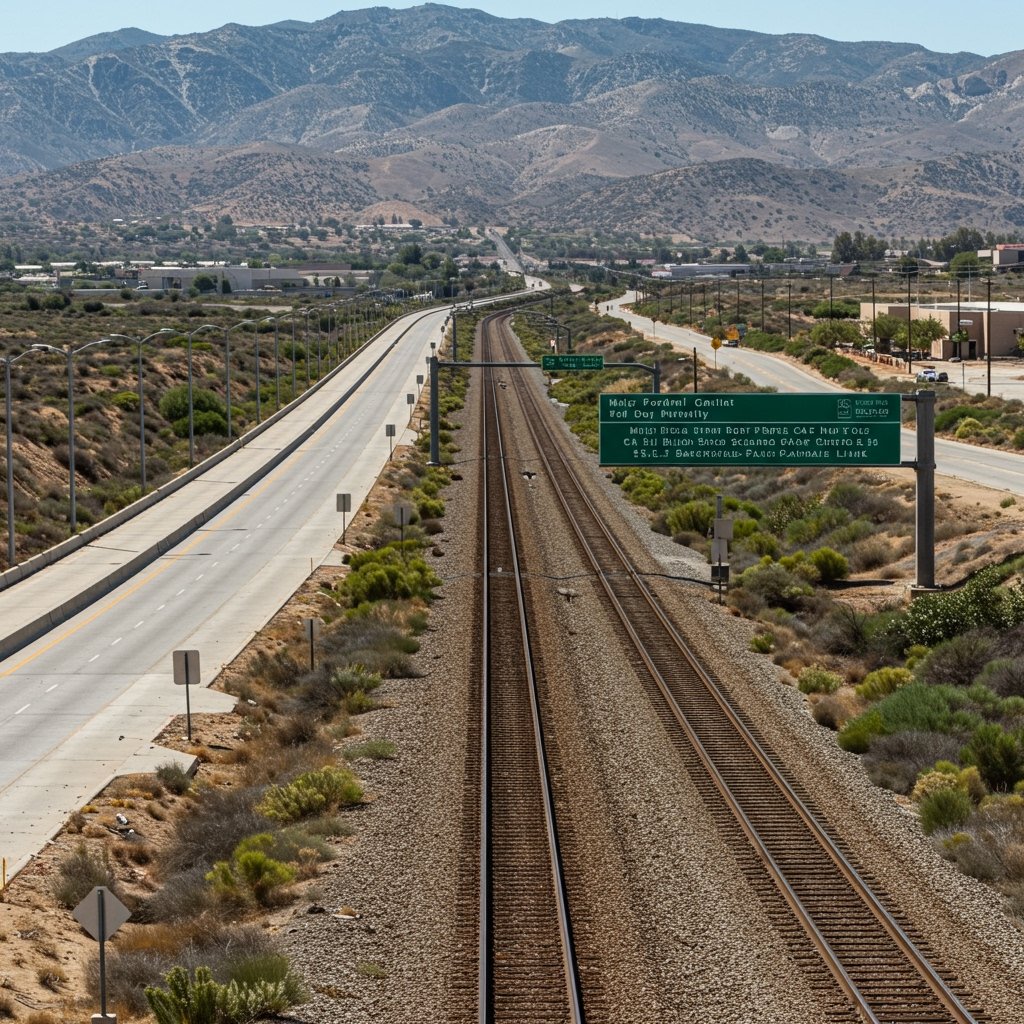
California High-Speed Rail Secures Landmark $3.1 Billion Federal Investment
Sacramento, CA – The California High-Speed Rail Authority today announced a transformative infusion of federal capital, receiving a substantial grant totaling $3.1 billion from the U.S. Department of Transportation. This critical funding award is specifically earmarked for a pivotal section of the ambitious statewide project: the challenging 45-mile segment connecting Bakersfield in the Central Valley to Palmdale in Los Angeles County.
The grant represents a significant boost to the long-awaited high-speed rail initiative, often cited as the most complex infrastructure project currently underway in the United States. Officials from the California High-Speed Rail Authority highlighted that securing this funding is absolutely vital for bridging a crucial geographic and logistical gap. The Bakersfield-Palmdale segment is essential for enabling the operational high-speed line currently under construction in the Central Valley to eventually extend southward and integrate with the vast transportation network of the Los Angeles metropolitan area.
Bridging the Gap: The Strategic Importance of the Bakersfield-Palmdale Segment
The 45-mile stretch between Bakersfield and Palmdale is widely recognized as one of the most technically demanding portions of the proposed route. It involves navigating significant topographical challenges, including crossing the Tehachapi Mountains. Successful completion of this segment will physically connect the railway infrastructure being built across the relatively flat terrain of the Central Valley to the high desert region of Palmdale, which is planned as a future multimodal transportation hub with potential connections to conventional rail services and other transit options serving Southern California.
Project planners have long identified this link as indispensable for the viability and utility of the high-speed rail system. Without the Bakersfield-Palmdale section, the considerable investment already made in the Central Valley would lack a direct, high-speed connection to the major population and economic centers of the Southland. The $3.1 billion federal grant provides the necessary financial muscle to confront the engineering complexities and construction costs associated with traversing this mountainous barrier, moving the project closer to its goal of providing efficient, reliable intercity travel.
Project Timeline and Next Steps
With this major funding now secured, the California High-Speed Rail Authority is preparing to advance the Bakersfield-Palmdale segment towards construction. Project officials have indicated that work on this critical section is currently anticipated to commence in late 2025. This timeline reflects the detailed planning, environmental review processes, and complex engineering design required before heavy construction can begin on such a challenging route.
The ambitious target service date for this specific portion of the high-speed rail line is approximately 2030. This means that, contingent upon timely execution and the successful resolution of potential construction challenges, passengers could potentially travel by high-speed train between Bakersfield and Palmdale within the next decade. While this segment is not the final piece of the statewide puzzle, its completion by 2030 would mark a monumental step forward, establishing a high-speed link across a previously impassable terrain and laying the groundwork for future expansion.
Towards a Connected California: The Broader Vision
The Bakersfield-Palmdale segment is a key component of the larger vision for a comprehensive high-speed rail network connecting Northern and Southern California. The ultimate goal of the California High-Speed Rail project remains the establishment of a continuous high-speed line spanning approximately 500 miles from San Francisco to the Los Angeles basin. The sections currently under active construction are primarily located within the Central Valley, building the foundational infrastructure for high-speed operations.
The injection of $3.1 billion specifically targeting the Bakersfield-Palmdale route underscores the federal government’s commitment to the project and its recognition of the segment’s importance in realizing the full connectivity objective. The successful completion of this link is seen by project proponents as a major step towards achieving the long-held goal of connecting the state’s two largest metropolitan areas via high-speed rail, significantly reducing travel times and offering an alternative to air and automobile travel.
The grant will support essential pre-construction activities, land acquisition, and the start of heavy civil engineering work, including tunneling and bridge construction necessary to navigate the mountainous terrain. While challenges, including funding for future segments and potential cost escalations, remain, the securing of this $3.1 billion federal grant is undeniably a transformative event for the California High-Speed Rail project, significantly accelerating progress on one of its most critical and technically demanding sections.