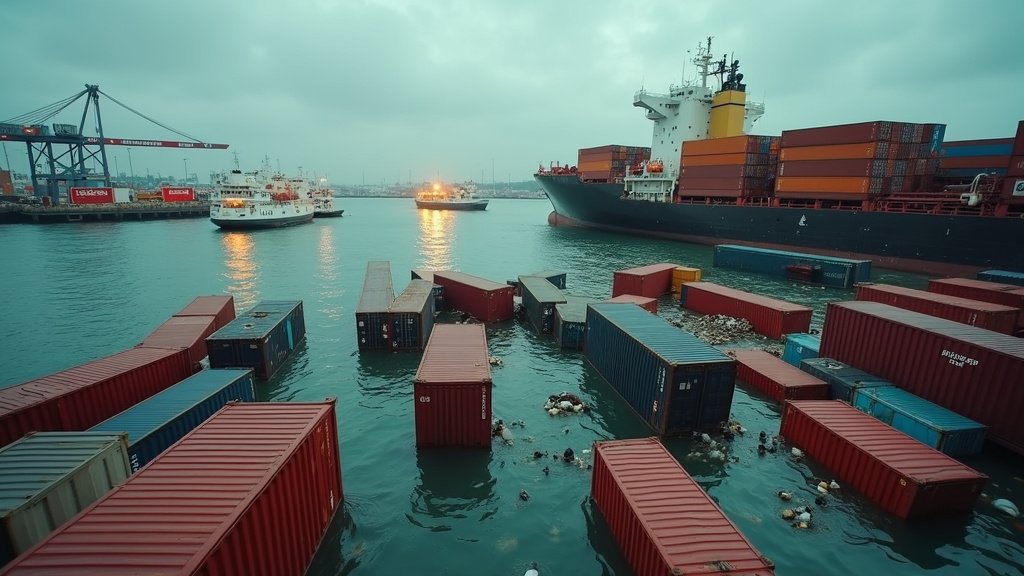
Dramatic video captured the chaotic scene at the Port of Long Beach on Tuesday morning, September 9, 2025, as approximately 67 cargo containers toppled off the vessel “Mississippi,” plunging into the busy waterway. The incident has prompted a swift response from multiple agencies and launched comprehensive investigations into its cause.
Containers Tumble Overboard at Pier G
The incident occurred shortly before 9 a.m. at Terminal G of the Port of Long Beach, a critical hub for trans-Pacific trade on the west coast. The vessel, identified as the “Mississippi,” a 2024-built, 5,500 TEU containership operating under a Portuguese flag and chartered by ZIM, was reportedly in the process of offloading when multiple stacks of containers collapsed. Early estimates from the U.S. Coast Guard placed the number of containers lost overboard at around 67, though some reports indicated up to 75 containers may have fallen.
The contents of these containers included general cargo such as clothing, furniture, shoes, and electronics. Items like airline amenity kits from Delta Air Lines and Missoni have reportedly washed ashore, underscoring the diverse nature of the cargo being transported.
Immediate Response and Contained Impact
Video footage of the containers tumbling into the water quickly circulated, showcasing the dramatic nature of the event. In response, a Unified Command was established, comprising representatives from the U.S. Coast Guard, Long Beach Fire Department, Long Beach Police Department, and the Port of Long Beach. The U.S. Coast Guard swiftly set up a 500-yard safety zone around the “Mississippi” and began issuing hourly marine safety broadcasts to alert other vessels of the navigation hazards.
Fortunately, no major injuries were reported. However, a smaller clean-air barge connected to the “Mississippi” to capture emissions was struck and damaged by several fallen containers, resulting in a “very light” oil sheen. One worker aboard the barge sustained a sprained ankle while evading falling debris, but did not require hospitalization.
While operations at Pier G were temporarily suspended to facilitate salvage and safety assessments, the broader impact on the Port of Long Beach was minimized. Other terminals and port operations remained largely unaffected, with the terminal reopening to truckers later that day. Recovery efforts, including the deployment of booms to contain floating containers and sonar surveys to locate submerged ones, were immediately initiated.
Investigations Launched into Cause
The precise cause of the container collapse remains under active investigation. The U.S. Coast Guard and the National Transportation Safety Board (NTSB) are jointly leading the inquiry. While port officials have classified the event as an accident, potential contributing factors such as crane malfunction, inherent cargo stack instability, or vessel listing are being examined, though no definitive cause has been determined.
Maritime experts note that while container losses at sea do occur, the scale of this incident at a major port is significant. The “Mississippi” had arrived from Shenzhen, China, two weeks prior to the incident, a route that has seen increased rerouting due to geopolitical events.
A Critical West Coast Gateway
The Port of Long Beach, a vital artery for the nation’s economy and a key player in west coast trade, handles millions of containers annually. This current news event highlights the complex logistical challenges and inherent risks associated with global shipping. The port was recently recognized as the “Best West Coast Seaport” for the seventh consecutive year by Asia Cargo News, underscoring its operational importance.
As salvage operations continue and investigations proceed, the focus remains on safely clearing the affected area and determining the factors that led to this unprecedented spill. The incident serves as a stark reminder of the continuous efforts required to ensure safety and efficiency in the vital shipping industry.