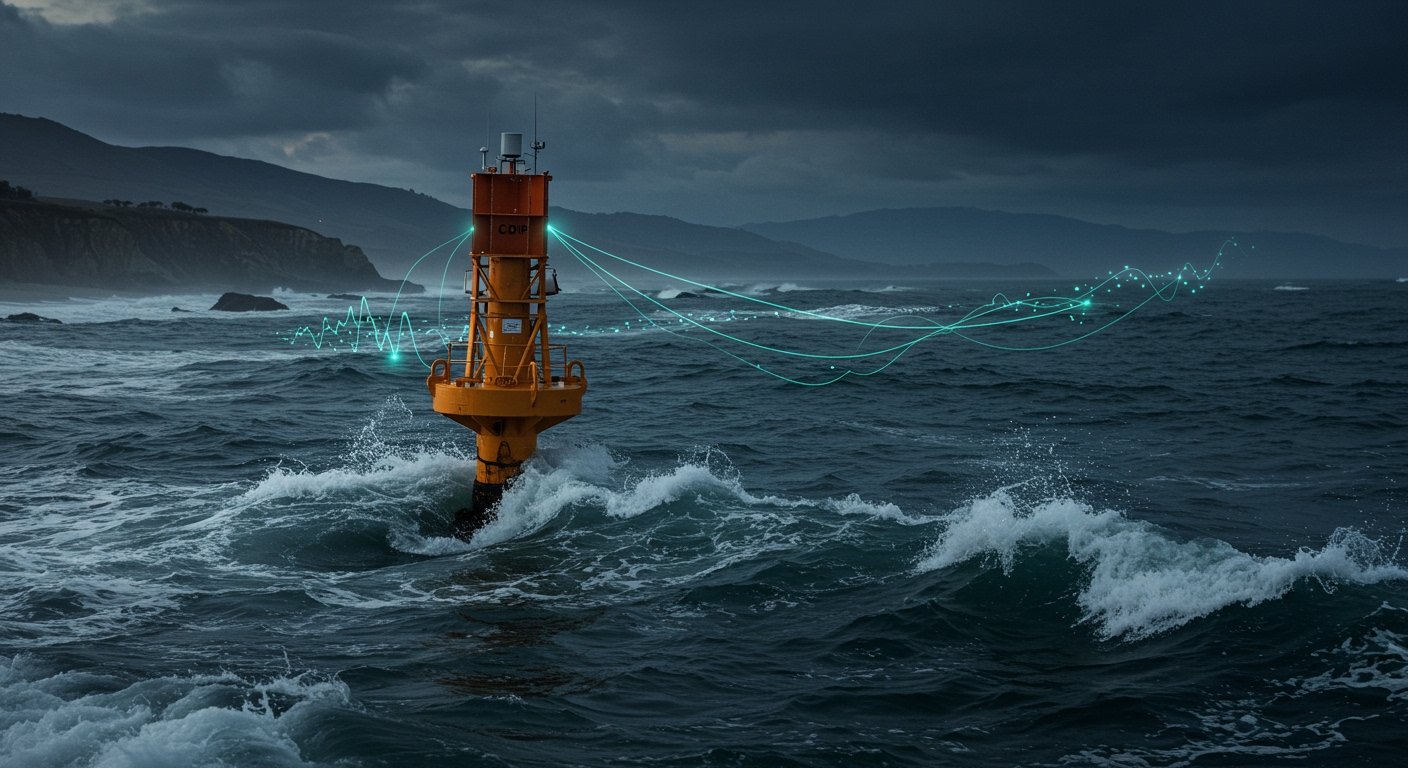
Coastal communities across the United States, particularly in California, face the potential for decreased accuracy in vital weather and ocean forecasts should a critical network of data-collecting buoys cease operations. The future of the Coastal Data Information Program (CDIP), a network comprising approximately 90 buoys strategically placed along the West, Gulf, and East coasts, as well as in the Pacific Islands, hangs in the balance, according to reporting.
These buoys serve as indispensable sentinels of the sea, collecting essential data on ocean waves. This information is not merely academic; it forms the backbone for forecasts utilized by a diverse array of groups, including scientists analyzing climate patterns, meteorologists predicting surf conditions and storm surges, boat captains navigating treacherous waters, and surfers seeking optimal wave conditions. The potential disruption of this data flow represents a significant concern for safety, commerce, and environmental monitoring.
The Lifeline of Coastal Data
The CDIP network, established and maintained through collaborative efforts, has for decades provided a continuous stream of high-quality wave data. This data is foundational for understanding complex ocean dynamics, forecasting wave height, period, and direction, and monitoring long-term coastal trends like erosion and sea-level rise impacts. Its value extends far beyond recreational surfing; it directly informs decisions related to coastal engineering, maritime safety, search and rescue operations, and climate research.
Chuck Mesa, chief of coastal engineering for the Army Corps of Engineers, Los Angeles District, has underscored the profound importance of this resource. Mesa emphasized the “significant value of this resource for a wide range of coastal users in the United States.” This highlights the broad dependency on CDIP data across various sectors critical to the nation’s coastal infrastructure and economy.
Potential Impact on Forecast Accuracy
The potential discontinuation of data from the CDIP network could lead to a tangible reduction in the accuracy of forecasts for California and other U.S. coastal regions. Without real-time, granular data from these strategically located buoys, weather models and forecasting tools would lose a crucial input. This could result in less reliable predictions for wave conditions, potentially impacting everything from daily beach forecasts to critical warnings for major storm events.
For meteorologists, the absence of CDIP data would mean relying on less precise sources or models that are not calibrated with direct ocean measurements. For boat captains, this could translate to navigating with less certainty about sea state conditions, increasing risks. For scientists, it hampers ongoing research into coastal processes and climate change effects. For coastal engineers like Mesa, it impacts the ability to design and maintain infrastructure resilient to ocean forces.
Uncertainty Clouds the Horizon
The article, authored by Science Reporter Jack Lee, points to a significant level of uncertainty surrounding the future availability of data from the program. The reasons behind this potential discontinuation were not detailed in the provided summary, but any interruption would create a critical data gap that could be challenging and costly to fill.
The reliance on CDIP data by federal agencies, state and local governments, private industries, and the general public underscores the widespread implications of its potential loss. The network represents a long-term investment in coastal monitoring infrastructure that provides a unique and vital service.
Stakeholders are now reportedly grappling with the prospect of this data source going offline and the subsequent challenges it would pose. Ensuring the continuity of such essential data collection programs is crucial for maintaining the integrity of environmental monitoring and public safety measures along the nation’s vast coastline. The coming months will likely reveal the fate of this critical network and its impact on the accuracy of forecasts relied upon by millions.