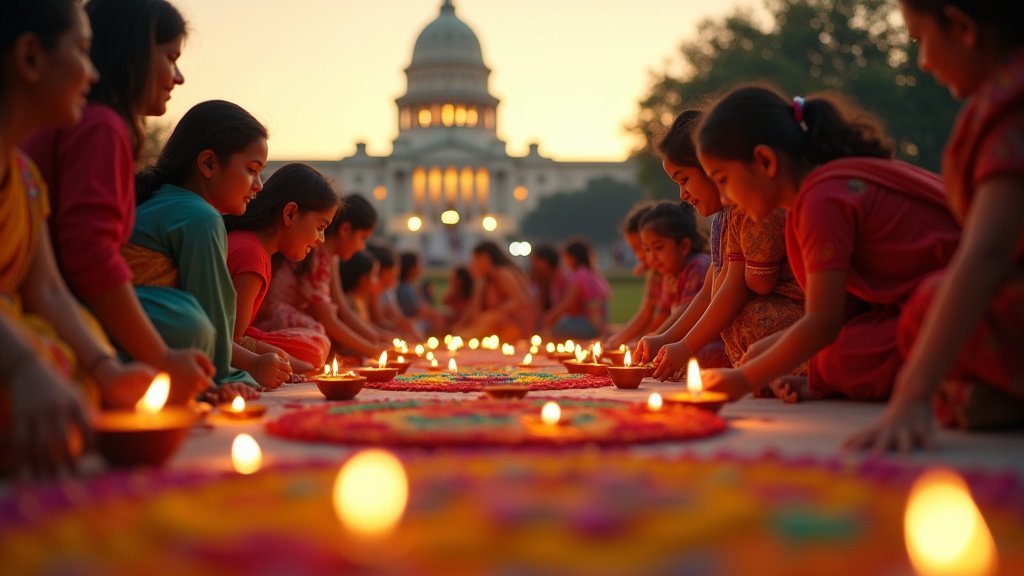
SACRAMENTO, CA – In a landmark decision that underscores California’s commitment to diversity and inclusion, Governor Gavin Newsom has signed Assembly Bill 268 (AB 268) into law, officially recognizing Diwali as a state holiday. This move makes California the first state on the West Coast to formally observe the Festival of Lights and the third U.S. state overall to do so, following Pennsylvania and Connecticut.
The new legislation, which will take effect on January 1, 2026, allows public schools and community colleges to close on Diwali, the Hindu festival of lights, and permits state employees to take paid time off to observe the holiday. This recognition is being hailed as a significant moment for the nearly one million South Asians who call California home, affirming the diaspora’s enduring legacy and contributions to the state’s social and economic fabric.
The Genesis of AB 268: A Push for Recognition
Assembly Bill 268, authored by Assemblymember Ash Kalra and co-sponsored by Assemblymember Darshana Patel, represents a culmination of years of grassroots advocacy and bipartisan collaboration. Kalra, the first Indian American elected to the California Legislature, championed the bill, emphasizing its symbolic and cultural importance. He stated that designating Diwali as a state holiday would uplift its message of hope, unity, and renewal to hundreds of thousands of Californians. The bill received broad support from various community organizations, including the Coalition of Hindus of North America (CoHNA) and the Hindu American Foundation (HAF).
“This recognition will allow millions in our Indian diaspora to fully embrace one of the world’s oldest holidays,” Kalra remarked, noting how it fosters greater understanding across cultures. The passage of AB 268 is seen not only as a recognition of the festival itself but also as a powerful affirmation of the Indian diaspora’s contributions to California’s economy, innovation, and civic life.
Practical Implications and Broader Inclusivity
The provisions within AB 268 are designed to make Diwali more accessible for celebration. Public schools and community colleges are now authorized to close on Diwali, with students attending those institutions able to take leave. For state employees, the law grants the option to elect paid time off for the holiday. This dual approach aims to accommodate the needs of both students and working professionals who celebrate the festival.
Furthermore, the bill acknowledges that Diwali is celebrated by multiple faiths, including Hindus, Sikhs, Jains, and Buddhists, ensuring broader inclusivity. For Sikhs, Diwali often coincides with Bandi Chhor Divas, marking the release of Guru Hargobind from imprisonment. Jains commemorate Lord Mahavira’s attainment of nirvana, while for Buddhists, it marks Emperor Ashoka’s embrace of Buddhism. The law also clarifies that Diwali is excluded from designation as a judicial holiday, allowing courts to remain open while state employees and educational institutions can observe the festival. Educational institutions may also incorporate activities that highlight Diwali’s meaning and significance.
A Milestone on the West Coast and Beyond
California’s designation of Diwali as a state holiday marks a significant step in the ongoing trend of cultural recognition across the United States. By becoming the first state on the West Coast to enact such a law, California joins Pennsylvania, which recognized Diwali in 2024, and Connecticut, which followed suit in 2025. New York City also made history by adding Diwali to its list of school holidays, with public schools closing for the festival for the first time in November 2024.
This widespread recognition reflects a growing national movement to celebrate cultural diversity and acknowledge the contributions of various communities. For the nearly one million Indian Americans residing in California, constituting approximately 20% of the nation’s Indian population, this news is particularly impactful. Community leaders have described the decision as a “radiant milestone” in California’s journey toward true inclusivity and a testament to the diaspora’s enduring legacy.
Symbolism of the Festival of Lights
Diwali, derived from the Sanskrit word “Deepavali,” meaning “a row of lights,” is universally known as the Festival of Lights. It symbolizes the triumph of light over darkness, good over evil, and knowledge over ignorance. The festival is traditionally celebrated with the lighting of oil lamps (diyas), fireworks, feasting, and prayers, all aimed at inviting prosperity, dispelling negativity, and renewing hope.
The core message of Diwali—hope, unity, and renewal—resonates deeply within California, a state that prides itself on its diverse populace. The legislation ensures that families can fully embrace traditions, such as crafting rangoli, preparing sweets (prasad), and performing pooja, without the conflict of work or school schedules.
Conclusion
The signing of AB 268 into law is more than just adding a holiday to the calendar; it is a powerful statement of inclusion and a recognition of the vibrant South Asian community that enriches California. This news brings a much-needed message of hope and celebration, allowing generations of Californians to honor their heritage openly and share its universal values of light, unity, and goodwill with the broader state. This development signifies an enduring triumph for diversity and a brighter future for all Californians. This important news is a testament to the evolving landscape of cultural recognition in the United States, especially on the West Coast.