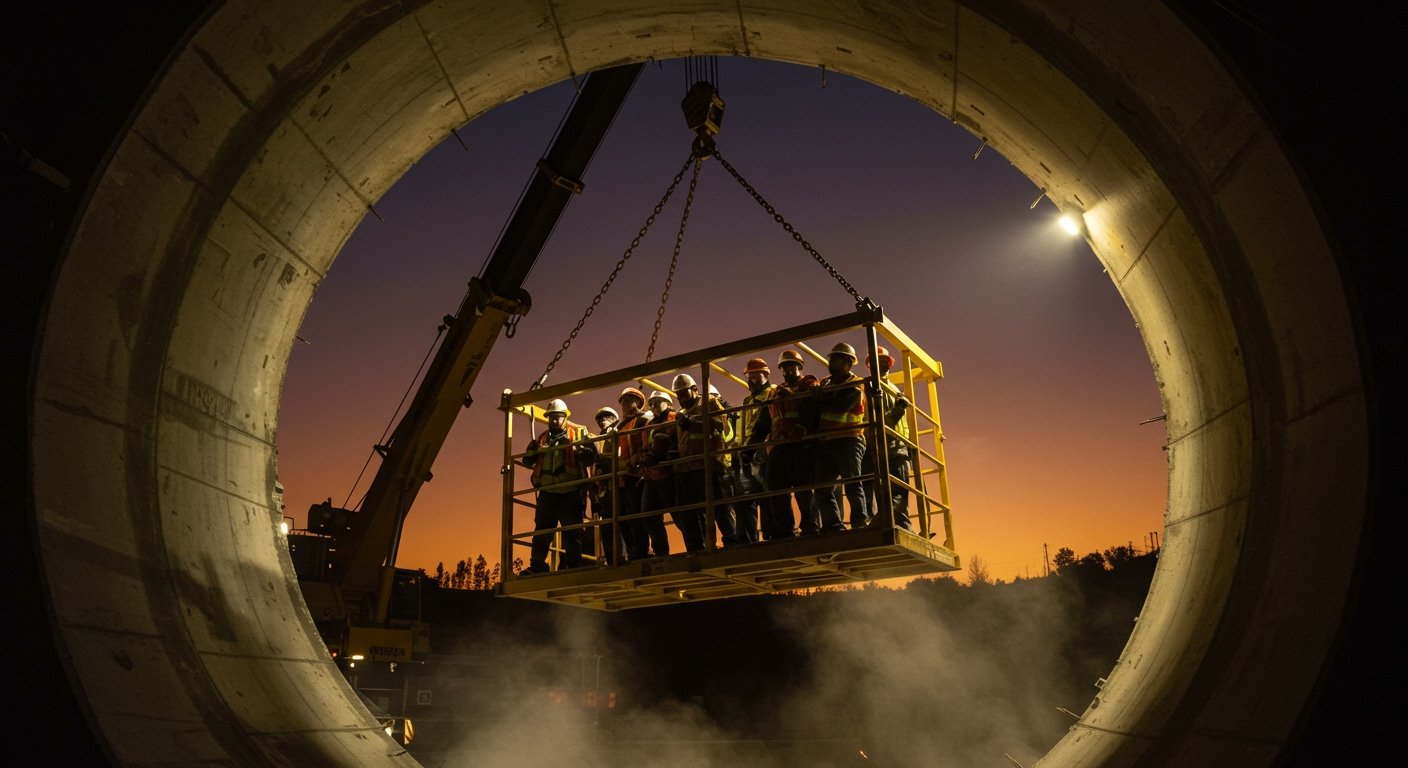
LOS ANGELES – Thirty-one construction workers were successfully rescued late Wednesday evening after a section of a large industrial tunnel, currently under construction in Los Angeles, experienced a partial collapse. The incident, which occurred deep underground, posed a significant threat, but quick assessment and action ensured the safety of all personnel involved.
The collapse took place within the vast subterranean passage being bored as part of a major infrastructure project. The affected area was situated between the tunnel boring machine, positioned approximately 5 miles (8 kilometers) from the tunnel’s entrance, and the location of the workers, who were approximately 6 miles (9.6 kilometers) in and roughly 400 feet (121 meters) below the surface.
Details of the Underground Obstruction
According to Michael Chee, a spokesperson for the Los Angeles County Sanitation Districts, the public agency overseeing the ambitious project, the collapse involved a section of loose soil. This material surged into the tunnel to a height of between 12 to 15 feet (3.6 to 4.5 meters), effectively creating a significant barrier within the confined space. The presence of this substantial mound of soil initially trapped the workers on one side, isolating them from the boring machine and the path back towards the entrance.
The Rescue Effort
Upon realizing the situation, the trapped workers demonstrated composure and resourcefulness. They were compelled to navigate over the unstable pile of collapsed soil to reach the tunnel boring machine, located on the other side of the obstruction. This maneuver, overcoming a potentially dangerous and unstable impediment up to 15 feet high, was a critical step in their self-rescue.
Once the workers reached the tunnel boring machine, they were able to utilize the infrastructure and communication channels available there. They were then transported back towards the tunnel’s opening. The final stage of their journey to safety involved being brought to the surface in a sturdy yellow cage, which was hoisted upwards by a crane stationed at the entrance site. This method is standard for transporting personnel and equipment in and out of such deep excavations, but on this occasion, it carried the weight of a successful rescue operation.
Remarkably, despite the perilous nature of the incident and the challenging conditions underground, no major injuries were reported among the 31 rescued construction workers. All personnel were accounted for and brought to the surface safely, a testament to emergency protocols and the resilience of the team.
Project Significance and Official Response
The tunnel is a key component of a broader wastewater management initiative commissioned by the Los Angeles County Sanitation Districts. Designed to be 18 feet (5.5 meters) wide and stretch approximately 7 miles (11.3 kilometers) in length, its crucial purpose is to transport treated wastewater from Los Angeles County facilities to the Pacific Ocean. The overall wastewater management project is estimated to cost $630 million and is part of a nearly $700 million project overseen by the Sanitation Districts. It is currently slated for completion by 2027.
The successful rescue drew attention from city officials. Los Angeles Mayor Karen Bass visited with some of the workers following their return to the surface. Mayor Bass lauded the positive outcome, calling it a “victory,” acknowledging the potential severity of the situation and the relief that all workers emerged unharmed.
Investigation Underway
The cause of the partial collapse is not immediately known and is now the subject of a formal investigation. Officials from the Los Angeles County Sanitation Districts stated that work on the tunnel project has been suspended. Operations will not resume until the cause of the collapse is definitively determined and the site is thoroughly assessed and deemed safe for workers to return. The investigation will likely examine geological conditions, construction methods, equipment performance, and safety procedures to understand what led to the failure and prevent future occurrences.
The incident highlights the inherent risks associated with large-scale subterranean construction projects, particularly in complex geological environments. While the successful rescue is a cause for relief and celebration, the focus now shifts to the meticulous process of investigation to ensure the safety and integrity of the remaining construction work and the successful completion of this vital infrastructure project.