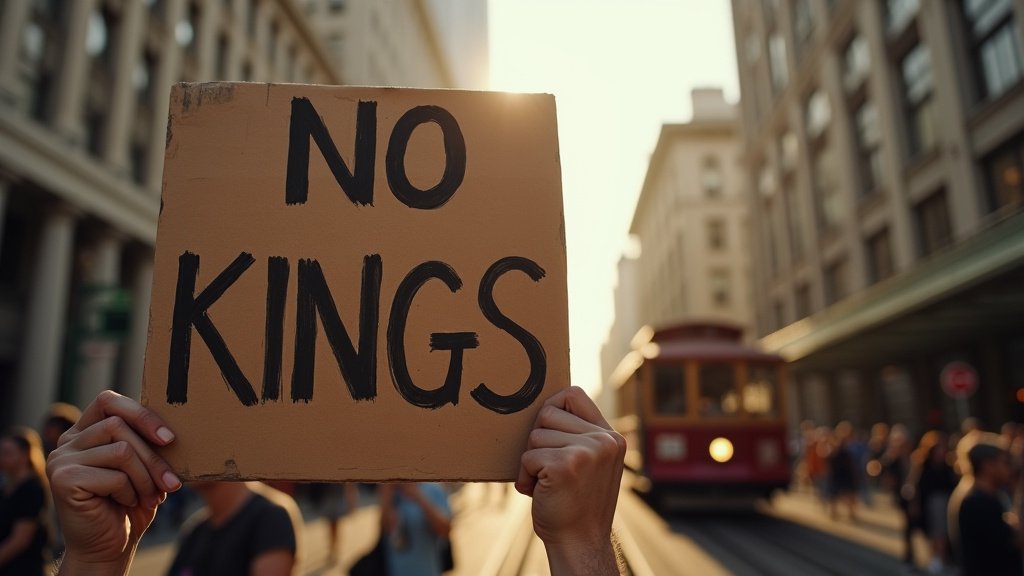
Thousands of demonstrators converged on major Bay Area cities to protest recent Trump administration policies, chanting ‘No Kings’ in a coordinated display of dissent.
- Protesters marched in San Francisco, Oakland, and San Jose to voice opposition to new executive orders.
- The ‘No Kings’ movement emphasizes concerns over perceived executive overreach and constitutional checks and balances.
- Law enforcement reported large, primarily peaceful crowds with minor traffic disruptions across major metropolitan arteries.
- Activist groups cited the demonstrations as the beginning of a sustained campaign against administration policy changes.
The Deep Dive
A Unified Voice of Dissent
The Bay Area has long served as a focal point for political expression, and this past week proved no exception as thousands of citizens took to the streets to voice their opposition to the current administration’s agenda. Under the banner of the ‘No Kings’ protests, individuals from various walks of life mobilized across San Francisco, Oakland, and San Jose. The demonstrations, which organizers described as a proactive pushback against what they characterize as an expansion of presidential power, signaled a deepening divide between the region and the federal government.
The slogans echoing off downtown skyscrapers and local government buildings centered on the core tenet of the U.S. Constitution: the separation of powers. Participants carried placards and banners questioning the legality of recent executive mandates, calling for congressional intervention and a return to traditional legislative processes. For many attendees, the sentiment was not merely one of disagreement with policy specifics, but a fundamental fear that democratic norms are being eroded by executive actions.
Regional Impact and Logistical Response
As the crowds swelled, municipal infrastructure in the Bay Area faced significant challenges. Transit systems, including BART and local bus networks, experienced heavy delays as participants moved through downtown cores. Local law enforcement agencies deployed increased patrols to manage the flow of traffic and ensure the safety of both protesters and local residents. While most rallies remained orderly, some intersections saw temporary standoffs, highlighting the high emotional stakes involved in the current national discourse.
Local civic leaders have had to strike a delicate balance. On one hand, protecting the right to assembly is paramount in Bay Area culture; on the other, maintaining the functionality of city streets is essential for residents and businesses. By the time evening approached, most gatherings began to dissipate, leaving behind a clear message that the region intends to remain a vocal hub of opposition to the current trajectory of federal policy.
The Long-Term Political Landscape
Beyond the immediate spectacle of the protests, political analysts are watching closely to see if this momentum translates into concrete civic action. The ‘No Kings’ mobilization is not viewed by organizers as a one-time event, but rather a catalyst for ongoing grassroots organizing. As legal battles against executive orders proceed in federal courts, the visibility of these street demonstrations serves to maintain public attention on the constitutional arguments being debated at the highest levels.
Moreover, the scale of these protests suggests that the administration’s policies are activating a segment of the electorate that may have been previously disengaged. With local elections and broader national political cycles approaching, the Bay Area’s energetic response provides a preview of the intense electoral and advocacy landscape expected in the coming months. Whether this energy will be sustained or tempered by political fatigue remains one of the defining questions for local organizers as they prepare for future demonstrations.
FAQ: People Also Ask
What does the ‘No Kings’ protest slogan signify?
It is a reference to the constitutional principle that the President of the United States is not an absolute monarch and is subject to the checks and balances established by the legislative and judicial branches.
Were there any major disruptions to public services?
While there were temporary traffic delays and minor disruptions to public transit routes in downtown areas, municipal services continued to operate, and no major public infrastructure damage was reported.
How are local officials responding to these demonstrations?
Local officials have largely focused on managing public safety and protecting the rights of citizens to protest peacefully, while working to minimize the impact on city residents and essential services.