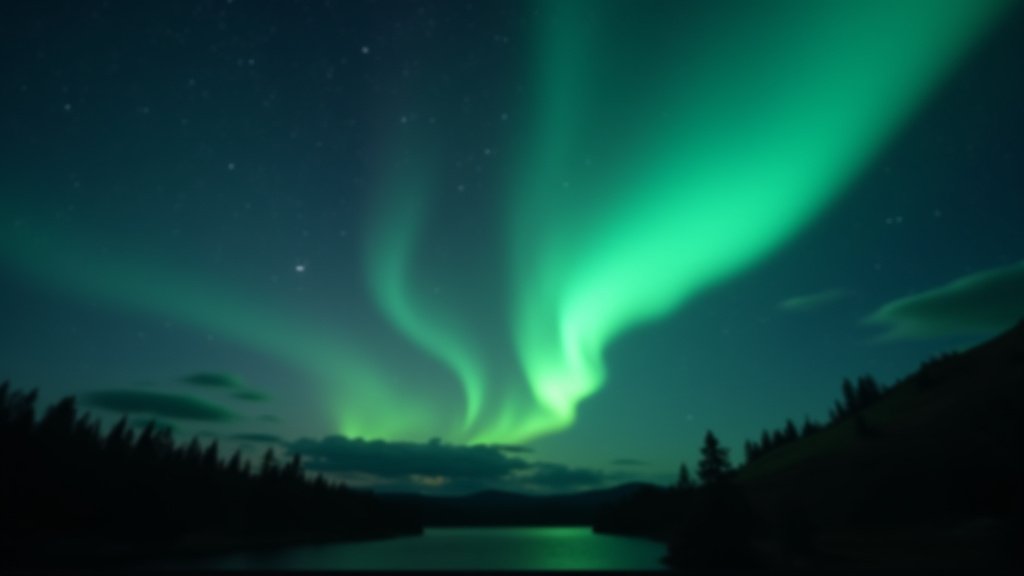
A breathtaking display of celestial activity occurred early Monday morning as a brilliant green fireball streaked across the sky over the Pacific Northwest. The event, witnessed by many from the Portland metro area to parts of southwest Washington, turned the pre-dawn darkness into a vivid spectacle. Lasting only a few seconds, the phenomenon was enough to capture the attention of early risers who documented the event with phones and cameras, subsequently flooding social media with footage and questions.
Reports indicate the meteor was spotted around 6:06 a.m.. Experts from the Oregon Museum of Science and Industry have suggested that the striking green color observed is often a result of magnesium within the object vaporizing as it heats up during its descent through Earth’s atmosphere. Nickel can also contribute to a green hue. This type of event is classified as a fireball, a particularly bright meteor visible up to 80 miles above the Earth’s surface.
The fireball was observed across multiple states, with the American Meteor Society logging numerous reports from Washington, Oregon, California, and beyond. Dashcam footage captured the streak, with one witness describing it as “bright” and “spectacular”. While fireballs are relatively common, with thousands occurring daily, most happen over oceans or unpopulated areas, making visible sightings like this one noteworthy.
Scientists are utilizing the crowdsourced videos and eyewitness accounts to triangulate the meteor’s trajectory and better understand the event. This data is crucial for determining whether the object was a natural meteoroid or potentially space debris. In most instances, fireballs disintegrate completely in the atmosphere, with very few fragments reaching the Earth’s surface. Even when they do, locating them can be exceptionally difficult. The bright green streak has ignited curiosity and wonder, serving as a powerful reminder of the dynamic nature of our solar system.
The Science Behind the Spectacle
The vivid green color of the fireball is a key indicator for scientists studying its composition. When meteors enter Earth’s atmosphere at high speeds, the friction causes them to heat up and vaporize. The elements within the meteoroid then emit light at specific wavelengths, creating the colors we observe. Magnesium is known to produce a bright blue-green light, while other elements like nickel can also contribute to green hues. Sodium, for example, would produce a yellow color, and magnesium can also appear blue-white.
These celestial visitors are essentially space rocks, ranging in size from dust grains to small asteroids, that encounter Earth’s gravitational pull and enter our atmosphere. The immense speed at which they travel, often tens of thousands of miles per hour, generates intense heat due to atmospheric friction. This process creates the brilliant light show we recognize as a meteor or, in this case, a particularly bright fireball.
Tracking Celestial Visitors
The American Meteor Society (AMS) plays a vital role in documenting these events. Their public fireball log allows individuals who witness such phenomena to submit detailed reports, including the time, location, and any captured media. This collective data is invaluable for researchers, enabling them to pinpoint the meteor’s path and analyze its characteristics. Government sensors and scientific programs also actively track and catalog these flashes to better understand the objects entering our skies and the energy they possess.
NASA’s Jet Propulsion Laboratory (JPL) Center for Near Earth Object Studies (CNEOS) archives data and light curves for similar incidents, providing insights into how brightness, altitude, and energy are measured to study incoming space rocks and potential risks. While the vast majority of fireballs burn up harmlessly high in the atmosphere, understanding their frequency, composition, and trajectories is crucial for planetary defense and scientific understanding.
Frequently Asked Questions
What caused the green fireball seen over the Pacific Northwest?
Experts believe the green fireball was a meteor burning up in Earth’s atmosphere. Its distinct green color is likely due to the vaporization of magnesium and possibly nickel within the meteoroid as it heated up due to atmospheric friction.
How common are fireballs?
Fireballs, which are exceptionally bright meteors, occur frequently. Thousands of meteors of fireball magnitude enter Earth’s atmosphere daily, but most are not visible because they occur over oceans or unpopulated areas, or during daylight hours.
Is it possible to find pieces of the meteor that created the fireball?
It is rare for fireballs to produce fragments that reach the Earth’s surface. If any pieces do survive, they are typically small, resemble common rocks, and are very difficult to locate unless they cause visible damage or leave a clear debris trail.