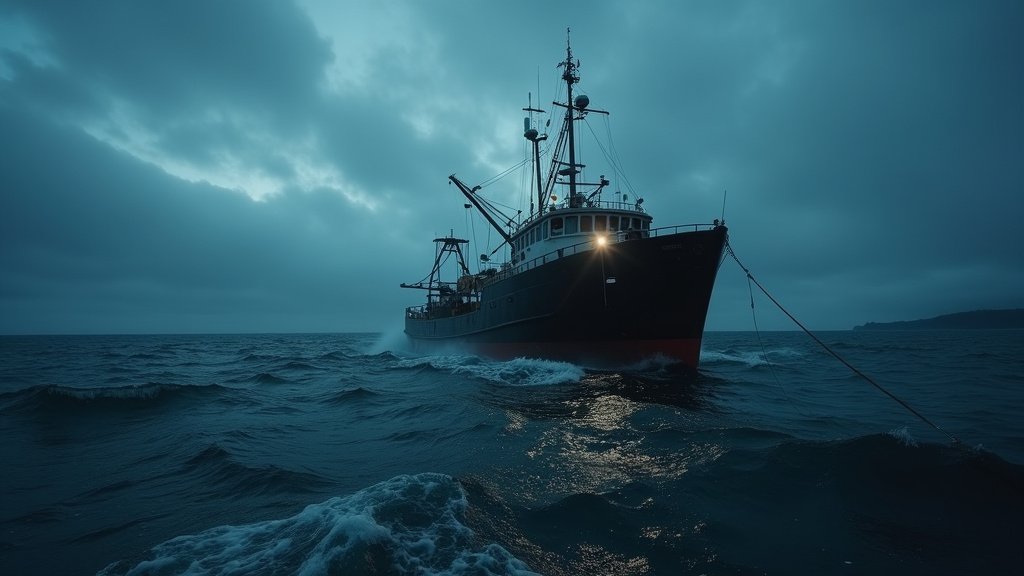
The vast Pacific Ocean has yielded another enigma off the California coast, with the recovery of the fishing vessel Karolee, found adrift and unmanned. The boat’s captain, Joel Kawahara, a respected 70-year-old fisherman from Quilcene, Washington, remains missing, leaving behind a trail of unanswered questions and a community grappling with his unexplained disappearance.
The ‘Ghost Ship’ Emerges Off the Coast
The unsettling discovery occurred when U.S. Coast Guard crews intercepted the Karolee approximately 60 miles southwest of Eureka, California. The vessel had been traveling south for several days, maintaining a steady course and speed of about four knots, as indicated by its Automatic Identification System (AIS). This remarkable journey of nearly 400 miles, from its last known position off Neah Bay, Washington, to the waters off Northern California, was undertaken without any human hand at the helm, leading to its grim moniker as a ‘ghost ship’.
When Coast Guard personnel boarded the Karolee on August 12th, they found the boat rigged for fishing, its lights illuminated, and its safety equipment, including a life raft, in place. However, there were no signs of distress, no debris, and most critically, no sign of Captain Joel Kawahara. A half-drunk cup of coffee sat on the helm, and his breakfast was unfinished, painting a picture of a sudden, inexplicable vanishing act.
A Lifelong Fisherman and Advocate Lost at Sea
Joel Kawahara was not just a fisherman; he was a deeply respected figure within the maritime community along the West Coast. Known for his passion for salmon recovery and conservation, Kawahara had dedicated his life to the ocean, even leaving a career at Boeing to fully embrace his calling as a fisherman. Friends and colleagues remember him as an experienced, meticulous individual who was deeply invested in the health of marine ecosystems and the future of his industry.
His commitment extended beyond the boat; he was an advocate who testified before lawmakers, participated in streamside tree plantings, and generously shared his catch and knowledge with others. His former deckhand recalled his profound connection to the water, stating that he “just wanted to go back to fishing,” and that it was clear he belonged on the water.
The Journey and the Silence
Kawahara departed from Neah Bay, Washington, on August 8th for a salmon fishing trip. His last communication was on the morning of August 8th, at approximately 7:30 a.m. After this last contact, concerns grew when he failed to check in over the weekend. Friends, including Heather Burns, were the first to raise the alarm, prompting the U.S. Coast Guard to launch an extensive search operation.
The AIS data provided crucial tracking information, showing the Karolee’s consistent southerly movement. However, repeated attempts by Coast Guard watchstanders and other mariners to establish radio contact with the vessel were met with silence. An aircrew from Air Station Sacramento, responding to the boat’s position, visually confirmed it was operational but found no one aboard. This eerie uniformity of the vessel’s state, coupled with the complete absence of its captain, deepened the mystery.
Coast Guard’s Extensive Search and Suspension
The U.S. Coast Guard mobilized significant resources for the search, deploying aircraft, helicopters, cutters, and small boats from Washington, Oregon, and California. The operation spanned over 18 hours, covering approximately 2,100 square miles and hundreds of miles of coastline and trackline. Despite these diligent efforts, no trace of Kawahara was found.
On August 13th, after exhausting all avenues and finding no further leads, the Coast Guard made the difficult decision to suspend the search. Commander Chelsey Stroud, search and rescue mission coordinator for the Coast Guard’s Northwest District, expressed the gravity of such decisions, stating, “Suspending a search for someone is the toughest decision we make in the Coast Guard.” The agency extended its deepest condolences to Kawahara’s family and friends.
Theories and Lingering Questions
The exact circumstances of Joel Kawahara’s disappearance remain a profound mystery. With no signs of distress, no indication of foul play, and all safety equipment accounted for, speculation has turned to the possibility of a sudden, unforeseen accident. Friends have suggested that a “freak occurrence” may have caused him to fall overboard, a terrifying scenario for any solo mariner. The image of his life jacket hanging neatly inside the cabin, rather than being worn, adds another layer to the puzzle.
The Coast Guard has indicated that they are not investigating the incident further, and there is no indication that another law enforcement agency has taken up the case. The Karolee was towed to Eureka, California, where it now sits moored, a silent testament to the perilous nature of working at sea and the enduring questions that lie beneath the waves.
As the news reverberates through the fishing communities along the West Coast, the story of Joel Kawahara and the Karolee serves as a somber reminder of the risks faced by those who make their living on the ocean. A friend, Dave Bitts, plans to sail the Karolee back to Seattle, a gesture of respect for a man who was lost doing what he loved. The incident remains a top news story, highlighting the inherent dangers and the profound mysteries the sea can hold.