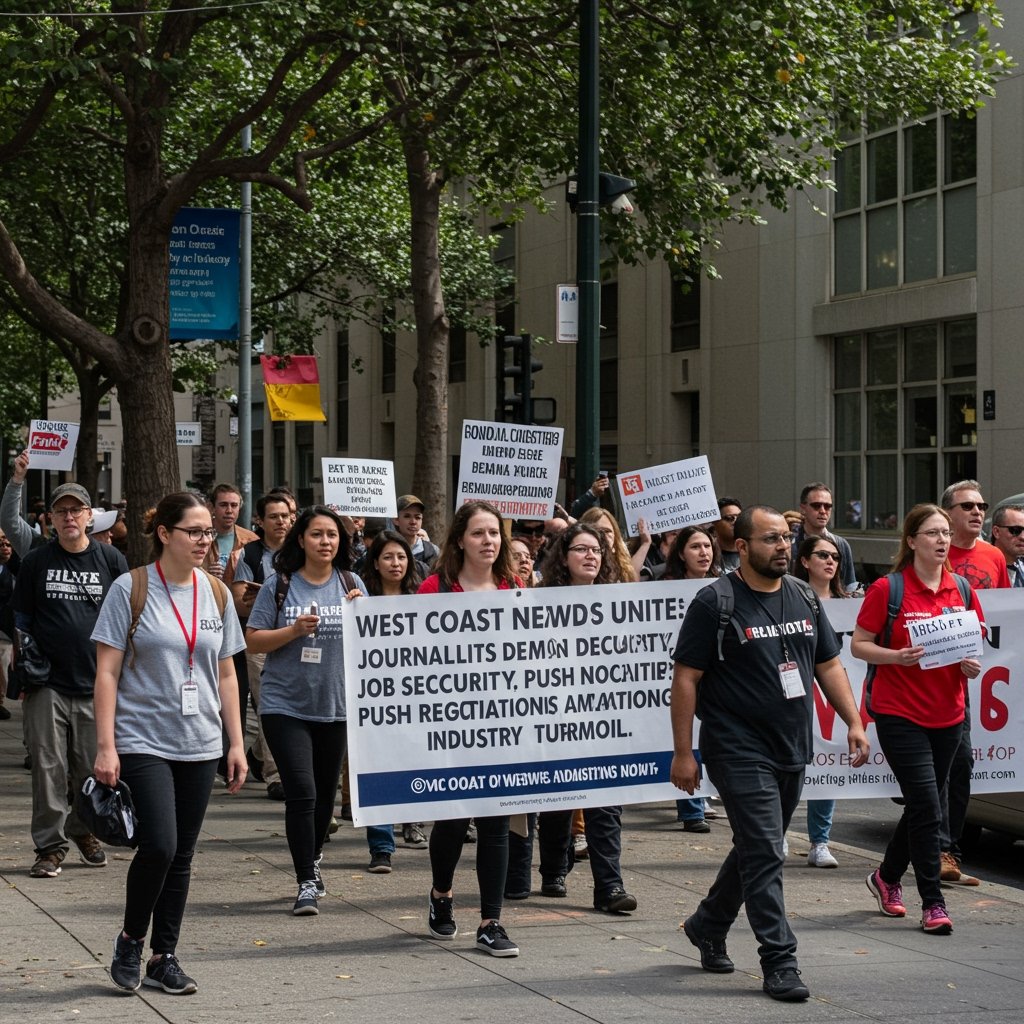
West Coast News Guilds Issue Joint Statement Amidst Industry Crisis
In a significant show of solidarity and a direct response to recent, widespread layoffs impacting newsrooms across the West Coast, News Guild chapters representing journalists at major newspapers in Los Angeles, San Francisco, and Seattle issued a unified joint statement on April 22, 2025. The statement serves as both a call to action for increased solidarity among media professionals and a formal announcement of an accelerated push in ongoing contract negotiations with their respective employers. This coordinated effort underscores the urgent need for enhanced protections for journalists navigating a precarious and rapidly changing media landscape.
The backdrop to this joint action is the series of substantial job cuts that have swept through the U.S. media industry over the past year, with the West Coast particularly hard hit. Newsrooms in major metropolitan areas like Los Angeles, San Francisco, and Seattle have seen veteran reporters, editors, and photographers depart in waves, often impacting crucial beats and reducing the capacity for in-depth local journalism. These layoffs are frequently attributed to broad “industry-wide financial pressures,” including declining traditional advertising revenue, challenges in digital monetization, and, in some cases, the financial strategies of hedge funds and private equity firms that have acquired legacy news organizations. The cumulative effect has been a chilling impact on newsroom morale and a growing sense of instability among journalists.
It is within this context of turbulence and uncertainty that the News Guild chapters collaboratively drafted and released their statement on April 22, 2025. By issuing a joint declaration, unions representing different news organizations in distinct geographic markets aim to demonstrate a unified front against the industry’s negative trends and to signal a collective resolve to fight for the future of journalistic jobs. The statement explicitly called for greater “solidarity among media workers,” recognizing that the challenges faced by journalists in Los Angeles are often mirrored in San Francisco and Seattle, and that a united approach can amplify their collective voice and leverage.
The core of the statement centered on the unions’ decision to accelerate their respective ongoing contract negotiations. For many newsrooms, collective bargaining agreements are the primary mechanism for establishing terms and conditions of employment, including critical provisions related to job security. By pushing for an accelerated timeline, the unions are signaling the immediate urgency of addressing job protections rather than waiting for the standard pace of negotiations to unfold. This reflects the unions’ perception that the current environment of layoffs necessitates swift action at the bargaining table.
Union leaders, speaking collectively through the statement and in subsequent comments, elaborated on the specific demands that are now at the forefront of these accelerated negotiations. Key among these are demands for “stronger job security clauses.” These clauses can take various forms, including requirements for employers to provide ample notice before layoffs, to follow clear and objective criteria for any workforce reductions, to explore alternatives to layoffs (such as buyouts or voluntary separation packages), and potentially to limit the circumstances under which layoffs can occur. The goal is to make it more difficult and costly for news organizations to reduce staffing solely based on short-term financial fluctuations.
In addition to preventing or mitigating job losses, the unions are also demanding “enhanced severance packages” for employees who are laid off. Recognizing that layoffs may still occur despite their best efforts, the unions are seeking to ensure that journalists who lose their jobs receive adequate financial support during their transition period. Enhanced severance can include longer pay continuation, extended health benefits, and resources for job searching or retraining. This is seen as a necessary protection given the difficulty journalists often face in finding comparable employment quickly in the current market.
A third critical demand highlighted by the union leaders is a commitment from employers to “maintaining editorial staffing levels.” This demand goes beyond individual job security and touches on the operational capacity of the newsroom itself. Unions are arguing that maintaining a certain baseline of journalistic staff is essential for fulfilling the public service mission of news organizations and for producing quality journalism. Reductions in staffing directly impact the ability to cover local communities, investigate important issues, and maintain editorial standards. The unions are seeking contractual language that would either set minimum staffing numbers or require consultation and agreement on any proposed reductions that would significantly impact newsroom capacity.
The joint statement and the decision to accelerate negotiations represent a “coordinated effort” among the West Coast News Guild chapters. This level of cross-newsroom, cross-city coordination is notable and suggests a strategic decision to amplify their message and potentially increase their bargaining power. By acting in concert, the unions aim to create a unified front that employers cannot easily dismiss. This collective approach is intended to establish “new benchmarks for protecting journalistic jobs” not just at individual newsrooms, but across the volatile West Coast media landscape. The hope is that successful negotiations in one market or with one employer can set a precedent or raise the standard for others.
The volatility of the West Coast media landscape is shaped by unique factors, including being a hub for digital disruption but also subject to the same economic pressures facing traditional media nationwide. The high cost of living in cities like Los Angeles, San Francisco, and Seattle also means that job security and adequate compensation are particularly critical for journalists working in these areas. The unions’ push comes at a time when the value of local journalism is increasingly recognized, even as its economic model remains challenged.
Ultimately, the joint statement issued on April 22, 2025, signifies a pivotal moment for West Coast newsroom unions. It represents a clear acknowledgment of the threats facing journalistic careers and a determined pushback through collective bargaining and inter-union solidarity. The accelerated negotiations and the focus on robust job security, severance, and staffing level clauses are aimed at building a more stable future for journalists and preserving the capacity for essential local news coverage in these major urban centers.